
Title
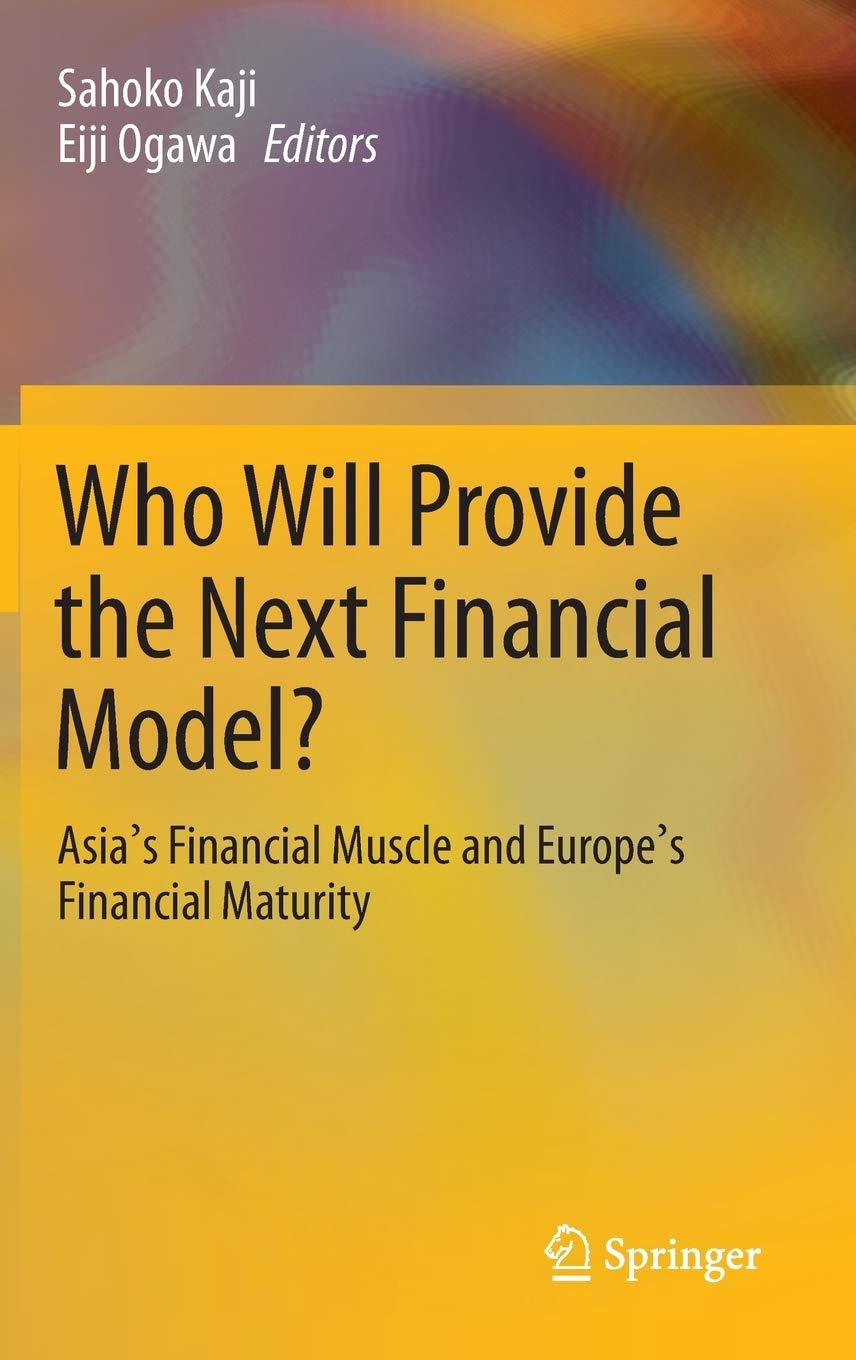
Who Will Provide the Next Financial Model?: Asia's Financial Muscle and Europe's Financial Maturity,Used
Sold by Ergodebooks, an authorized reseller.
Returns accepted within 30 days | support@ergodebooks.com
Shipping Information
- Free Standard Shipping — United States only
- Processing Time: 3–5 business days
- Estimated Delivery: 6–10 business days after dispatch
- Double-boxed, fully insured & discreetly packaged
- Tracking number sent via email once dispatched
Returns & Refund
Returns accepted within 30 days of delivery.
Damaged or Defective Item
Free return shipping + replacement or full refund
Wrong Item Received
Free return shipping + replacement or full refund
Change of Mind
Return shipping at customer's expense · 25% restocking fee applies
Payment Option

During the past 4 years, faith in the present financial model has been shaken in terms of policy, regulation, the financial sector itself, and exchangerate regimes. Past and present policies of the worlds most respected central banks have come under fire. Regulations that defined the system have undergone major reviews. Complicated financial instruments that provided new ways of financial intermediation have been exposed as culprits behind the financial meltdown. After 10 years of success, Europes single currency is under threat. In short, the established financial model not only has been unable to prevent the crisis but, arguably, has been a cause of it.There is no longer one obvious model that meets all needs. The burst of Japans bubble was followed by two lost decades. Before a contrite Japan completely adopted Western ways of finance, the Lehman shock hit, followed by the euro crisis. Monetary policy, financial regulation and the state of the financial sector all must be reconsidered. Currencies and exchange rates make up another important aspect of finance. If the Western model of finance is discredited, does that mean the dominance of Western currencies is also eroded? What does the crisis in the euro area tell us about exchange rate regimes in general?Clearly, a new model is needed, one that is conducive to both stability and prosperity. But who will provide it? This volume records the cumulative results of three EU Studies Institute (EUSI) conferences that have addressed these issues, and examines how Asia and Europe compare in the quest for the next financial model. While many books on Europe and Asia focus on integration and what Asia can learn from Europe, this book emphasizes mutual lessons in the common search for a new model.EU Studies InstituteThe EU Studies Institute in Tokyo (EUSI) was launched on 1 April 2009 as a consortium comprising Hitotsubashi University, Tsuda College, and Keio University. The Institute is sponsored by the European Commission for a fourandahalfyear period. As a centre for academic education, research and outreach, it aims to strengthen EUJapan relations. Details are at http://eusi.jp/content_en/
⚠️ WARNING (California Proposition 65):
This product may contain chemicals known to the State of California to cause cancer, birth defects, or other reproductive harm.
For more information, please visit www.P65Warnings.ca.gov.