If you have any questions, you are always welcome to contact us. We'll get back to you as soon as possible, withing 24 hours on weekdays.
Customer service
All questions about your order, return and delivery must be sent to our customer service team by e-mail at yourstore@yourdomain.com
Sale & Press
If you are interested in selling our products, need more information about our brand or wish to make a collaboration, please contact us at press@yourdomain.com
Help
If you have any questions, you are always welcome to contact us. We'll get back to you as soon as possible, withing 24 hours on weekdays.
Customer service
All questions about your order, return and delivery must be sent to our customer service team by e-mail at yourstore@yourdomain.com
Sale & Press
If you are interested in selling our products, need more information about our brand or wish to make a collaboration, please contact us at press@yourdomain.com
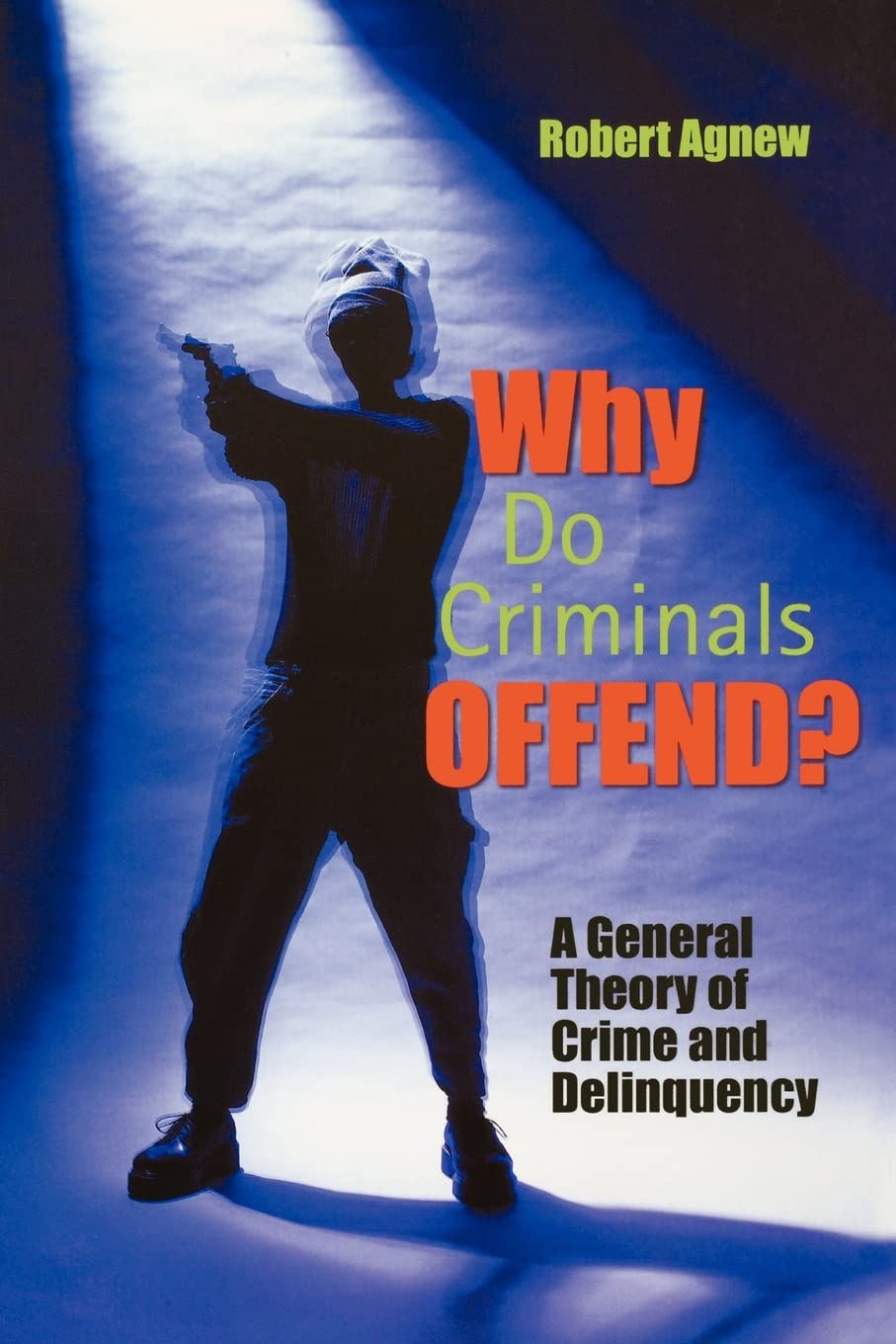
This book focuses on what is probably the most frequently asked question about crime: Why do criminals offend? Renowned criminologist Robert Agnew draws on a broad range of crime theories and the latest research to present a general theory of crime and delinquency, rich with studentaccessible examples. The general theory integrates the essential arguments from social learning, social control, selfcontrol, strain, labeling, social support, biopsychological, and other theories. And it draws on the latest research examining the relationship between crime, individual traits, and the social environmentincluding family, school, peer, and work environments.Agnew's general theory is concise and written at a level readily accessible to undergraduates. It provides a good sense of the major causes of crime and how they mutually influence and interact with one another to affect crime. Key points are illustrated with examples from qualitative and quantitative research, and each chapter ends with a set of thoughtprovoking discussion questions.While the book focuses on explaining why some individuals are more likely than others to offend, the general theory is also used to explain group differences in crime rates and patterns of offending over the life course. Further, the theory is used to evaluate current efforts to control crime and suggest new crime control initiatives.
⚠️ WARNING (California Proposition 65):
This product may contain chemicals known to the State of California to cause cancer,
birth defects, or other reproductive harm.
For MAP (Minimum Advertised Price) violations and Intellectual Property (IP) or Trademark concerns, please contact:
support@ergodebooks.com
⚠️ California Proposition 65 Warning: Some products sold on this website may expose you to chemicals known to the State of California to cause cancer, birth defects, or other reproductive harm. For more information, visit www.P65Warnings.ca.gov.