If you have any questions, you are always welcome to contact us. We'll get back to you as soon as possible, withing 24 hours on weekdays.
Customer service
All questions about your order, return and delivery must be sent to our customer service team by e-mail at yourstore@yourdomain.com
Sale & Press
If you are interested in selling our products, need more information about our brand or wish to make a collaboration, please contact us at press@yourdomain.com
Help
If you have any questions, you are always welcome to contact us. We'll get back to you as soon as possible, withing 24 hours on weekdays.
Customer service
All questions about your order, return and delivery must be sent to our customer service team by e-mail at yourstore@yourdomain.com
Sale & Press
If you are interested in selling our products, need more information about our brand or wish to make a collaboration, please contact us at press@yourdomain.com
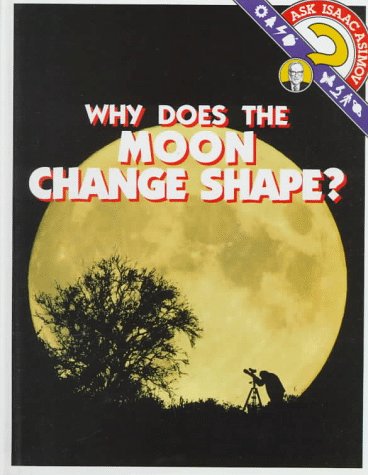
Product DescriptionExplains why the moon changes from crescent to full moon every twentynine and onehalf days.From School Library JournalGrade 13 Asimov spreads himself rather thin in these three titles designed to answer commonly asked questions. Shooting Star covers, in a hasty fashion, meteors and meteorites, their makeup, and their origins. In Twinkle , the author ranges more widely, discussing optical illusions, how air currents affect light, and the ways in which astronomers can compensate for the distortion or, with the Hubble Space Telescope, avoid it altogetheror rather, most of it. Asimov delivers a rare oversimplification when he claims that without air, starlight travels straight through space without bending.'' A simple description of the moon's phases in the third book is padded fore and aft by a general introductory essay, a demonstration using a ball and a flashlight, a brief discussion of lunar calendars, and perfunctory back matter. All three titles feature colorful photos and paintings with inset largetype texts, very brief bibliographies, and appended address lists. The information here is available elsewhere, but older, lessable readers may prefer these to Branley's Shooting Stars (1989) and The Moon Seems to Change (1987, both Crowell), which are plainly aimed at younger audiences. John Peters, New York Public LibraryCopyright 1992 Reed Business Information, Inc.
⚠️ WARNING (California Proposition 65):
This product may contain chemicals known to the State of California to cause cancer,
birth defects, or other reproductive harm.
For MAP (Minimum Advertised Price) violations and Intellectual Property (IP) or Trademark concerns, please contact:
support@ergodebooks.com
⚠️ California Proposition 65 Warning: Some products sold on this website may expose you to chemicals known to the State of California to cause cancer, birth defects, or other reproductive harm. For more information, visit www.P65Warnings.ca.gov.