
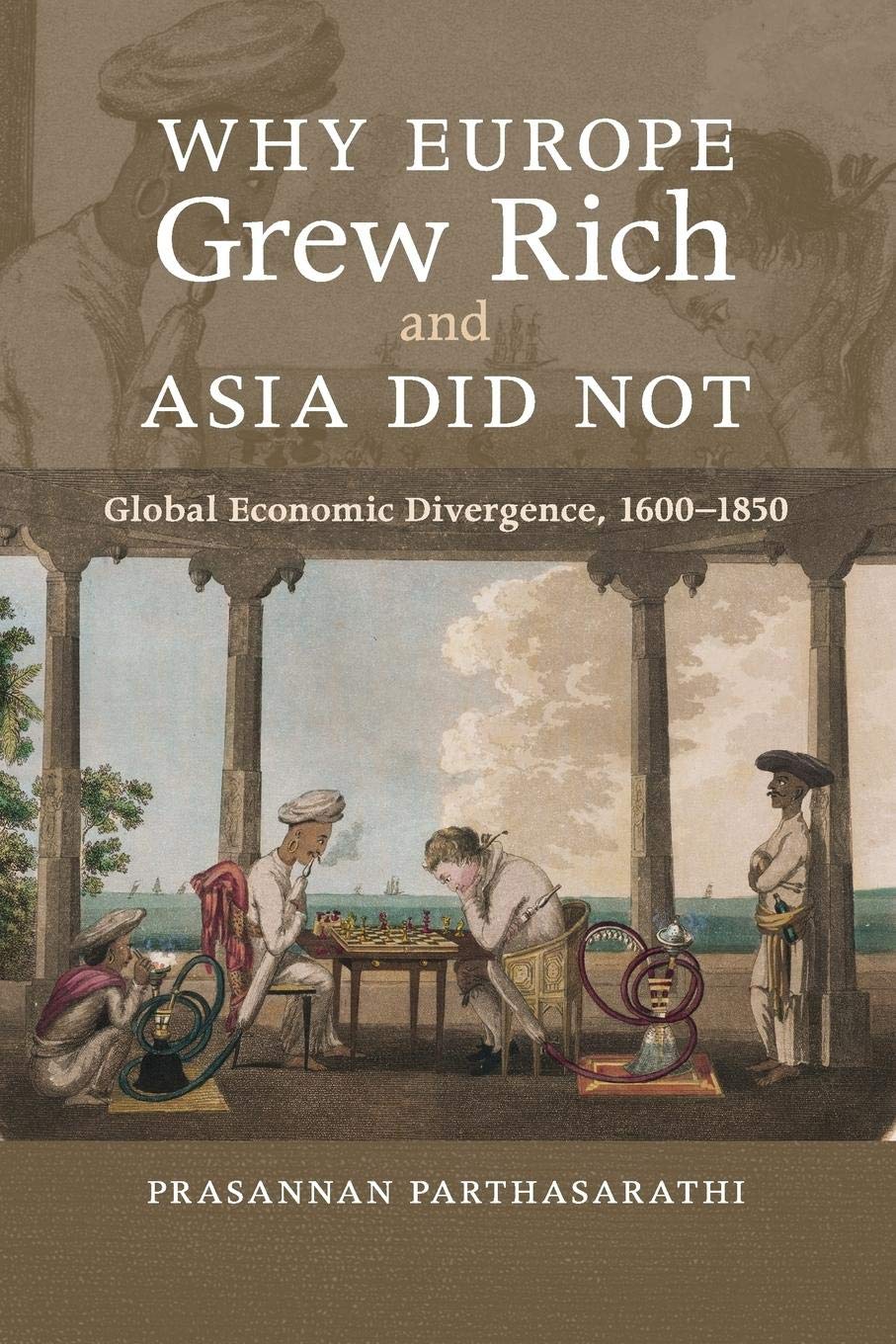
Title
Why Europe Grew Rich and Asia Did Not: Global Economic Divergence, 16001850,New
Sold by Ergodebooks, an authorized reseller.
Returns accepted within 30 days | support@ergodebooks.com
Shipping Information
- Free Standard Shipping — United States only
- Processing Time: 3–5 business days
- Estimated Delivery: 6–10 business days after dispatch
- Double-boxed, fully insured & discreetly packaged
- Tracking number sent via email once dispatched
Returns & Refund
Returns accepted within 30 days of delivery.
Damaged or Defective Item
Free return shipping + replacement or full refund
Wrong Item Received
Free return shipping + replacement or full refund
Change of Mind
Return shipping at customer's expense · 25% restocking fee applies
Payment Option

Why Europe Grew Rich and Asia Did Not provides a striking new answer to the classic question of why Europe industrialized from the late eighteenth century and Asia did not. Drawing significantly from the case of India, Prasannan Parthasarathi shows that in the seventeenth and eighteenth centuries, the advanced regions of Europe and Asia were more alike than different, both characterized by sophisticated and growing economies. Their subsequent divergence can be attributed to different competitive and ecological pressures that in turn produced varied state policies and economic outcomes. This account breaks with conventional views, which hold that divergence occurred because Europe possessed superior markets, rationality, science, or institutions. It offers instead a groundbreaking rereading of global economic development that ranges from India, Japan and China to Britain, France, and the Ottoman Empire and from the textile and coal industries to the roles of science, technology, and the state.
⚠️ WARNING (California Proposition 65):
This product may contain chemicals known to the State of California to cause cancer, birth defects, or other reproductive harm.
For more information, please visit www.P65Warnings.ca.gov.
- Q: What is the main thesis of 'Why Europe Grew Rich and Asia Did Not'? A: The main thesis of the book argues that the economic divergence between Europe and Asia from 1600 to 1850 can be attributed to different competitive and ecological pressures that led to varied state policies and economic outcomes.
- Q: Who is the author of this book? A: The author of 'Why Europe Grew Rich and Asia Did Not' is Prasannan Parthasarathi.
- Q: What are the key themes explored in the book? A: Key themes include global economic development, the historical similarities between Europe and Asia, and the impact of state policies on economic outcomes.
- Q: When was this book published? A: The book was published on August 11, 2011.
- Q: How many pages does the book have? A: The book consists of 380 pages.
- Q: What is the format of this book? A: This book is available in paperback binding.
- Q: Is this book suitable for academic study? A: Yes, this book is suitable for academic study, particularly in fields such as history, economics, and global studies.
- Q: Does the book include case studies? A: Yes, the book draws significantly from historical case studies, particularly focusing on India and its economic context.
- Q: What is the edition of this book? A: This book is a first edition.
- Q: What condition is the book in? A: The book is in new condition.