
Title
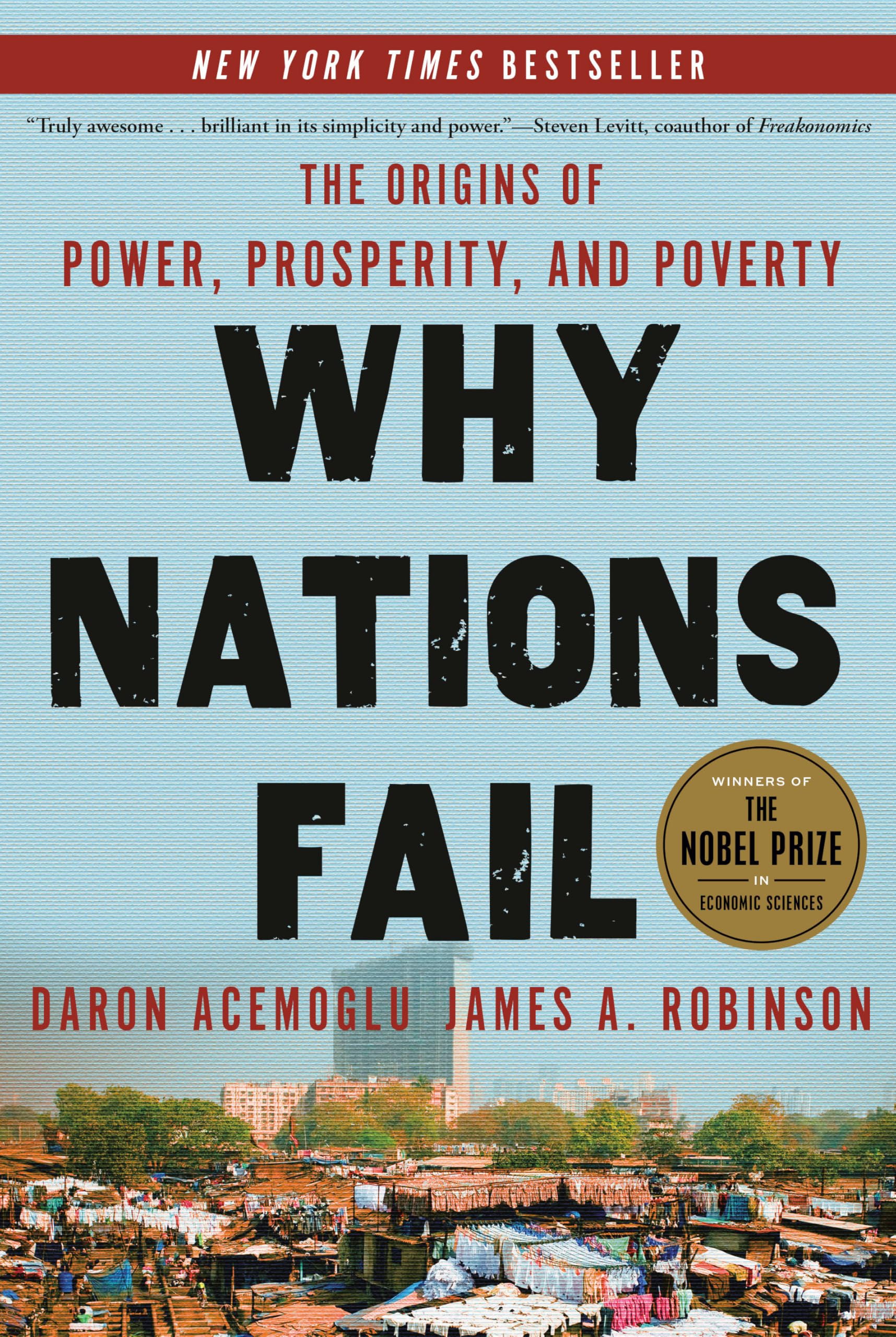
Why Nations Fail: The Origins Of Power, Prosperity, And Poverty
Sold by Ergodebooks, an authorized reseller.
Returns accepted within 30 days | support@ergodebooks.com
Shipping Information
- Free Standard Shipping — United States only
- Processing Time: 3–5 business days
- Estimated Delivery: 6–10 business days after dispatch
- Double-boxed, fully insured & discreetly packaged
- Tracking number sent via email once dispatched
Returns & Refund
Returns accepted within 30 days of delivery.
Damaged or Defective Item
Free return shipping + replacement or full refund
Wrong Item Received
Free return shipping + replacement or full refund
Change of Mind
Return shipping at customer's expense · 25% restocking fee applies
Payment Option

New York Times And Wall Street Journal Bestseller ? From Two Winners Of The 2024 Nobel Prize In Economic Sciences, ?Who Have Demonstrated The Importance Of Societal Institutions For A Country?S Prosperity??A Wildly Ambitious Work That Hopscotches Through History And Around The World To Answer The Very Big Question Of Why Some Countries Get Rich And Others Don?T.?The New York Timesfinalist: Financial Times And Goldman Sachs Business Book Of The Year Award ? One Of The Best Books Of The Year: The Washington Post, Financial Times, The Economist, Businessweek, Bloomberg, The Christian Science Monitor, The Plain Dealerwhy Are Some Nations Rich And Others Poor, Divided By Wealth And Poverty, Health And Sickness, Food And Famine? Is It Culture, The Weather, Or Geography That Determines Prosperity Or Poverty? As Why Nations Fail Shows, None Of These Factors Is Either Definitive Or Destiny.Drawing On Fifteen Years Of Original Research, Daron Acemoglu And James Robinson Conclusively Show That It Is Our Manmade Political And Economic Institutions That Underlie Economic Success (Or The Lack Of It). Korea, To Take Just One Example, Is A Remarkably Homogenous Nation, Yet The People Of North Korea Are Among The Poorest On Earth While Their Brothers And Sisters In South Korea Are Among The Richest. The Differences Between The Koreas Is Due To The Politics That Created Those Two Different Institutional Trajectories. Acemoglu And Robinson Marshal Extraordinary Historical Evidence From The Roman Empire, The Mayan Citystates, The Soviet Union, The United States, And Africa To Build A New Theory Of Political Economy With Great Relevance For The Big Questions Of Today, Among Them:? Will China?S Economy Continue To Grow At Such A High Speed And Ultimately Overwhelm The West?? Are America?S Best Days Behind It? Are We Creating A Vicious Cycle That Enriches And Empowers A Small Minority??This Book Will Change The Way People Think About The Wealth And Poverty Of Nations . . . As Ambitious As Jared Diamond?S Guns, Germs, And Steel.?Businessweek
⚠️ WARNING (California Proposition 65):
This product may contain chemicals known to the State of California to cause cancer, birth defects, or other reproductive harm.
For more information, please visit www.P65Warnings.ca.gov.
- Q: What is the page count of 'Why Nations Fail'? A: This book contains five hundred forty-four pages. It provides an in-depth exploration of the origins of power, prosperity, and poverty.
- Q: What type of binding does this book have? A: This book is available in paperback binding. This makes it more lightweight and portable for readers.
- Q: Who are the authors of 'Why Nations Fail'? A: The authors are Daron Acemoglu and James Robinson. They are Nobel Prize winners in Economic Sciences for their contributions to the field.
- Q: How should I read 'Why Nations Fail'? A: You can read this book at your own pace. It is suitable for anyone interested in economics, history, and social sciences.
- Q: Is 'Why Nations Fail' suitable for young readers? A: This book is not specifically targeted at children. Its complex themes may be more appropriate for adults and older teens.
- Q: What themes are explored in 'Why Nations Fail'? A: The book explores themes of political and economic institutions and their impact on prosperity and poverty. It discusses historical contexts and case studies.
- Q: How should I care for my paperback copy of 'Why Nations Fail'? A: To keep it in good condition, store it in a cool, dry place. Avoid exposure to moisture and sunlight to prevent damage.
- Q: Can I clean the cover of 'Why Nations Fail'? A: Yes, you can gently wipe the cover with a soft, dry cloth. Avoid using any cleaning solutions that could damage the material.
- Q: Does 'Why Nations Fail' have a shelf life? A: Books do not have a specific shelf life. If kept in proper conditions, this book can last for many years.
- Q: What should I do if my copy of 'Why Nations Fail' arrives damaged? A: If your book arrives damaged, contact the seller for return or exchange options. Most sellers have customer service policies to assist you.
- Q: Is there a warranty for 'Why Nations Fail'? A: Books typically do not come with a warranty. However, you should check with the seller for return policies.
- Q: How does 'Why Nations Fail' compare to other economic books? A: This book is often compared to 'Guns, Germs, and Steel' by Jared Diamond. Both books explore complex historical themes, but from different perspectives.
- Q: Who would benefit from reading 'Why Nations Fail'? A: Anyone interested in understanding economic disparities will benefit. It is particularly useful for students of economics, politics, and history.
- Q: What makes 'Why Nations Fail' a bestseller? A: It is a bestseller due to its compelling arguments and research by Nobel Prize winners. The book addresses fundamental questions about wealth and poverty.
- Q: Are there any notable awards for 'Why Nations Fail'? A: Yes, it is a finalist for the Financial Times and Goldman Sachs Business Book of the Year Award. It has also been recognized by several major publications.