
Title
Why New Systems Fail: An Insider's Guide to Successful IT Projects,New
Sold by Ergodebooks, an authorized reseller.
Returns accepted within 30 days | support@ergodebooks.com
Shipping Information
- Free Standard Shipping — United States only
- Processing Time: 3–5 business days
- Estimated Delivery: 6–10 business days after dispatch
- Double-boxed, fully insured & discreetly packaged
- Tracking number sent via email once dispatched
Returns & Refund
Returns accepted within 30 days of delivery.
Damaged or Defective Item
Free return shipping + replacement or full refund
Wrong Item Received
Free return shipping + replacement or full refund
Change of Mind
Return shipping at customer's expense · 25% restocking fee applies
Payment Option

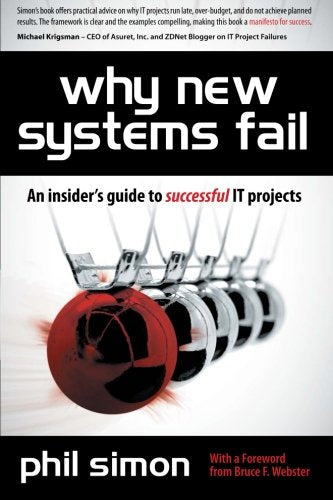
Book cover is incorrect. I assure you. This is Why New Systems Fail.A Fortune 500 manufacturing company spent millions attempting to implement a new enterprise resource planning (ERP) system. Across the globe, a 150employee marketing firm built and tried to implement a proprietary customer relationship management (CRM) system. For two very different companies doing two very different things, the outcomes were identical. In each case, the organization failed to activate and use its system as initially conceived by senior management.And these two organizations are hardly alone.On the contrary, research indicates that more than three in five IT projects fail. Many miss their deadlines. Others exceed their initial budgets, often by ghastly amounts. Even systems activated on time and under budget often fail to produce their expected results and almost immediately experience major problems. Although the statistics are grim, there is at least some good news: these failures can be averted. Organizations often lack the necessary framework to minimize the chance of system failure before, during, and after beginning IT projects.Why New Systems Fail provides such a framework, with specific tools, tips, and insight from the perspective of a seasoned, independent consultant with more than a decade of related experience. The book examines in great detail the root causes of system failures. Detailed case studies, examples, and lessons from actual system implementations are presented in an informative, straightforward, and very readable manner. More than a theoretical or technical text, this book offers pragmatic advice for organizations both deploying new systems and maintaining existing ones.
⚠️ WARNING (California Proposition 65):
This product may contain chemicals known to the State of California to cause cancer, birth defects, or other reproductive harm.
For more information, please visit www.P65Warnings.ca.gov.
- Q: What is the main focus of the book 'Why New Systems Fail'? A: The book focuses on the reasons behind the failure of IT projects and offers a framework to help organizations successfully implement new systems.
- Q: Who is the author of 'Why New Systems Fail'? A: The author is Phil Simon, a seasoned consultant with over a decade of experience in the field of IT project management.
- Q: What type of organizations can benefit from this book? A: Both large corporations and smaller firms can benefit, as the book provides insights applicable to various types of IT projects, including ERP and CRM systems.
- Q: How does the book address the issue of IT project failures? A: It examines root causes of failures through detailed case studies and provides practical tools and tips to minimize the chances of failure.
- Q: What is the publication date of 'Why New Systems Fail'? A: The book was published on February 23, 2010.
- Q: How many pages does the book have? A: The book contains 320 pages.
- Q: What is the format of 'Why New Systems Fail'? A: The book is available in paperback format.
- Q: Is 'Why New Systems Fail' suitable for beginners in IT project management? A: Yes, the book is written in an informative and straightforward manner, making it accessible for beginners and experienced professionals alike.
- Q: What edition of the book is available? A: The book is available in its first edition.
- Q: What condition is the book in? A: The book is listed as being in good condition.