
Title
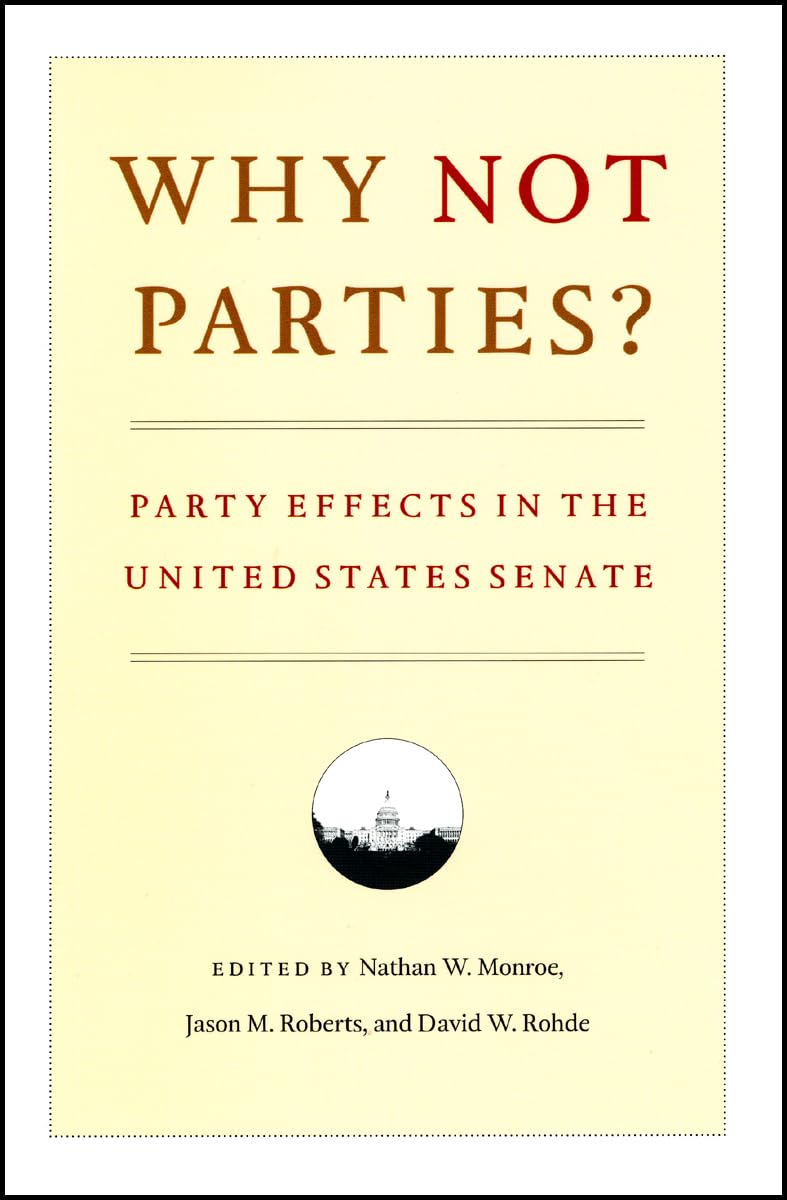
Why Not Parties?: Party Effects in the United States Senate,New
Sold by Ergodebooks, an authorized reseller.
Returns accepted within 30 days | support@ergodebooks.com
Shipping Information
- Free Standard Shipping — United States only
- Processing Time: 3–5 business days
- Estimated Delivery: 6–10 business days after dispatch
- Double-boxed, fully insured & discreetly packaged
- Tracking number sent via email once dispatched
Returns & Refund
Returns accepted within 30 days of delivery.
Damaged or Defective Item
Free return shipping + replacement or full refund
Wrong Item Received
Free return shipping + replacement or full refund
Change of Mind
Return shipping at customer's expense · 25% restocking fee applies
Payment Option

Product DescriptionRecent research on the U.S. House of Representatives largely focuses on the effects of partisanship, but the strikingly less frequent studies of the Senate still tend to treat parties as secondary considerations in a chamber that gives its members far more individual leverage than congressmen have. In response to the recent increase in senatorial partisanship, Why Not Parties? corrects this imbalance with a series of original essays that focus exclusively on the effects of parties in the workings of the upper chamber.Illuminating the growing significance of these effects, the contributors explore three major areas, including the electoral foundations of parties, partisan procedural advantage, and partisan implications for policy. In the process, they investigate such issues as whether party discipline can overcome Senate mechanisms that invest the most power in individuals and small groups; how parties influence the making of legislation and the distribution of pork; and whether voters punish senators for not toeing party lines. The result is a timely corrective to the notion that parties dont matter in the Senatewhich the contributors reveal is far more similar to the lower chamber than conventional wisdom suggests.About the AuthorNathan W. Monroe is assistant professor of political science at the University of California, Merced.Jason M. Roberts is assistant professor of political science at the University of Minnesota.David W. Rohde is the Ernestine Friedl Professor of Political Science at Duke University.
⚠️ WARNING (California Proposition 65):
This product may contain chemicals known to the State of California to cause cancer, birth defects, or other reproductive harm.
For more information, please visit www.P65Warnings.ca.gov.