
Title
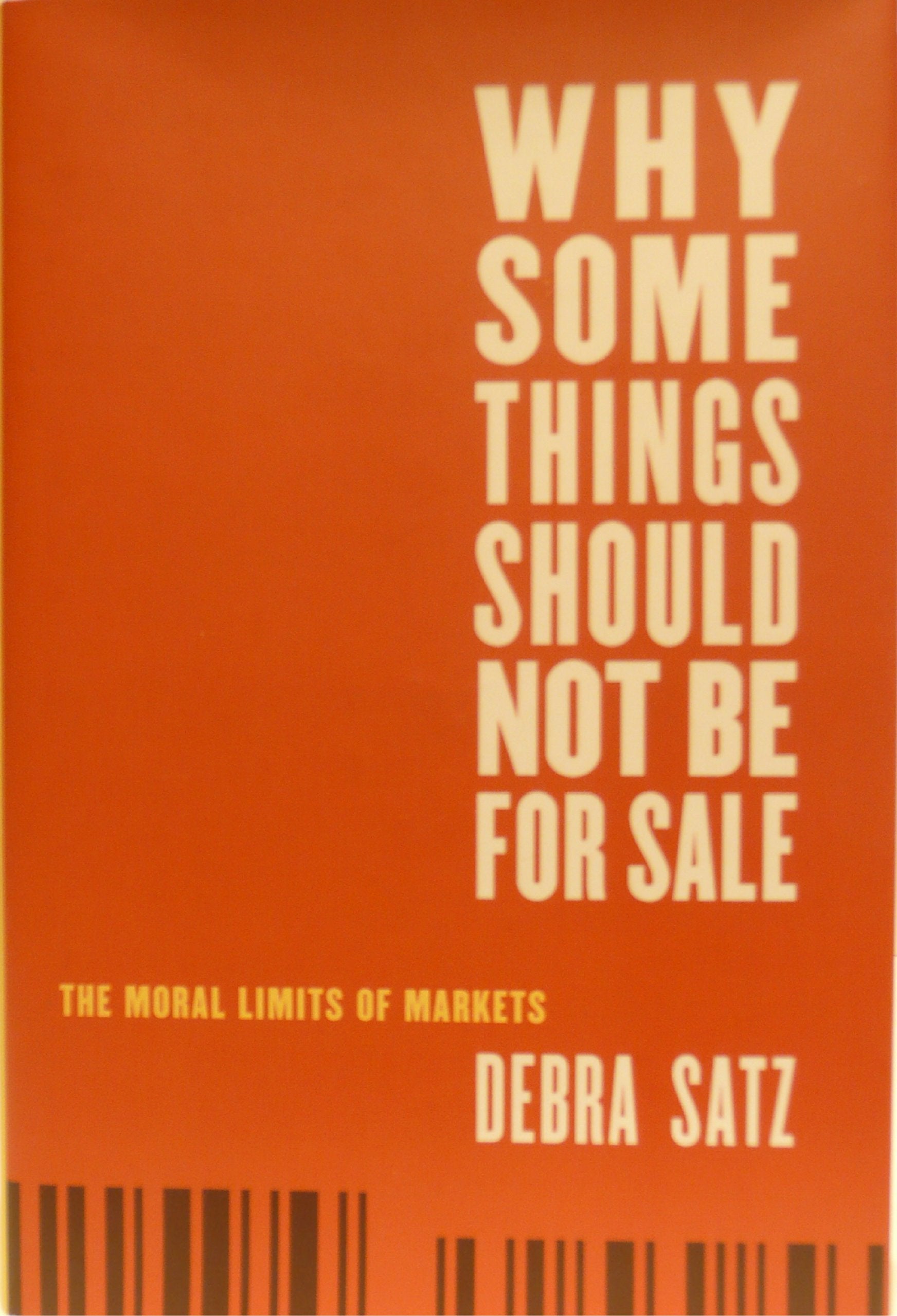
Why Some Things Should Not Be for Sale: The Moral Limits of Markets (Oxford Political Philosophy),Used
Sold by Ergodebooks, an authorized reseller.
Returns accepted within 30 days | support@ergodebooks.com
Shipping Information
- Free Standard Shipping — United States only
- Processing Time: 3–5 business days
- Estimated Delivery: 6–10 business days after dispatch
- Double-boxed, fully insured & discreetly packaged
- Tracking number sent via email once dispatched
Returns & Refund
Returns accepted within 30 days of delivery.
Damaged or Defective Item
Free return shipping + replacement or full refund
Wrong Item Received
Free return shipping + replacement or full refund
Change of Mind
Return shipping at customer's expense · 25% restocking fee applies
Payment Option

What's wrong with markets in everything? Markets today are widely recognized as the most efficient way in general to organize production and distribution in a complex economy. And with the collapse of communism and rise of globalization, it's no surprise that markets and the political theories supporting them have seen a considerable resurgence. For many, markets are an allpurpose remedy for the deadening effects of bureaucracy and state control. But what about those markets we might label noxiousmarkets in addictive drugs, say, or in sex, weapons, child labor, or human organs? Such markets arouse widespread discomfort and often revulsion.In Why Some Things Should Not Be for Sale, philosopher Debra Satz takes a penetrating look at those commodity exchanges that strike most of us as problematic. What considerations, she asks, ought to guide the debates about such markets? What is it about a market involving prostitution or the sale of kidneys that makes it morally objectionable? How is a market in weapons or pollution different than a market in soybeans or automobiles? Are laws and social policies banning the more noxious markets necessarily the best responses to them? Satz contends that categories previously used by philosophers and economists are of limited utility in addressing such questions because they have assumed markets to be homogenous. Accordingly, she offers a broader and more nuanced view of marketsone that goes beyond the usual discussions of efficiency and distributional equalityto show how markets shape our culture, foster or thwart human development, and create and support structures of power.An accessibly written work that will engage not only philosophers but also political scientists, economists, legal scholars, and public policy experts, this book is a significant contribution to ongoing discussions about the place of markets in a democratic society.
⚠️ WARNING (California Proposition 65):
This product may contain chemicals known to the State of California to cause cancer, birth defects, or other reproductive harm.
For more information, please visit www.P65Warnings.ca.gov.
- Q: How many pages does this book have? A: This book has two hundred sixty-four pages. It provides an in-depth exploration of ethical considerations surrounding markets.
- Q: What is the binding type of this book? A: The binding type of this book is hardcover. This makes it durable and suitable for frequent use.
- Q: What are the dimensions of this book? A: The dimensions of this book are one point one inches in thickness, six point three inches in width, and nine point three inches in height. These measurements make it easy to handle and store.
- Q: What is the main topic of this book? A: The main topic of this book is the moral limits of markets. It discusses the ethical implications of commodifying certain goods and services.
- Q: Who is the author of this book? A: The author of this book is Debra Satz. She is a prominent philosopher specializing in ethics and political philosophy.
- Q: Is this book suitable for academic study? A: Yes, this book is suitable for academic study. It engages with complex philosophical and ethical issues relevant to political science and economics.
- Q: How can I read this book? A: You can read this book by purchasing it or borrowing it from a library. It is accessible to anyone interested in ethics and market dynamics.
- Q: Is this book appropriate for casual readers? A: Yes, this book is appropriate for casual readers. Its engaging writing style makes it accessible to a general audience interested in ethical debates.
- Q: How should I store this book? A: You should store this book upright on a shelf to prevent warping. Keeping it in a dry, cool place can also help preserve its condition.
- Q: Is this book safe for young readers? A: No, this book may not be safe for young readers. It discusses complex and potentially sensitive topics that may not be suitable for children.
- Q: What are the key themes of this book? A: The key themes of this book include ethical implications of commodification, market dynamics, and the role of markets in society. It invites critical thinking about moral limits.
- Q: Can I use this book for a research paper? A: Yes, you can use this book for a research paper. It provides substantial philosophical insights that can support various arguments.
- Q: Are there any specific markets discussed in this book? A: Yes, the book discusses markets in addictive drugs, prostitution, and human organs, among others. It critically analyzes why these markets are ethically problematic.
- Q: What is the publisher of this book? A: The publisher of this book is Oxford University Press, USA. They are well-regarded for publishing academic and philosophical works.
- Q: What audience is this book intended for? A: This book is intended for a diverse audience, including philosophers, political scientists, and general readers interested in ethics. It engages with a wide range of ethical discussions.