
Title
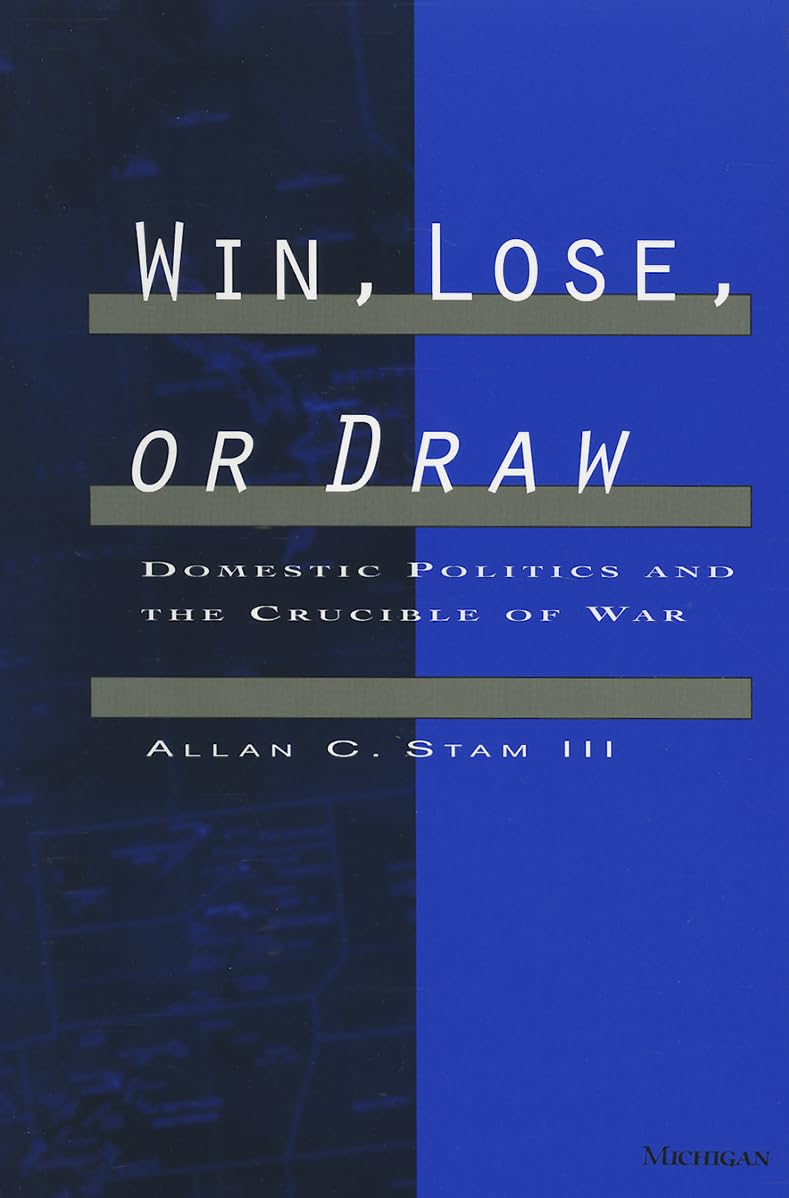
Win, Lose, or Draw: Domestic Politics and the Crucible of War,Used
Sold by Ergodebooks, an authorized reseller.
Returns accepted within 30 days | support@ergodebooks.com
Shipping Information
- Free Standard Shipping — United States only
- Processing Time: 3–5 business days
- Estimated Delivery: 6–10 business days after dispatch
- Double-boxed, fully insured & discreetly packaged
- Tracking number sent via email once dispatched
Returns & Refund
Returns accepted within 30 days of delivery.
Damaged or Defective Item
Free return shipping + replacement or full refund
Wrong Item Received
Free return shipping + replacement or full refund
Change of Mind
Return shipping at customer's expense · 25% restocking fee applies
Payment Option

While the factors affecting the initiation of war have been extensively studied, the factors that determine the outcome of war have been neglected. Using quantitative data and historical illustrations from the early 1800s to the late 1980s, Allan Stam investigates the relative effect on war outcomes of both the choices leaders must make during war and the resources they have at their disposal. Strategy choices, along with decisions about troop levels and defense spending, are not made in a vacuum, according to Stam, but are made in the crucible of domestic politics. Because of domestic political constraints, states must frequently choose less than optimal strategies in the international arena. Stam shows how we must go beyond simply counting resources and look at the process or strategy by which they are employed as the key factor determining who will win.Challenging the assumptions of many realist and neorealist thinkers on war and interstate conflict, Stam shows how domestic political factors affect the outcome of war. Using a rational choice analysis, Stam looks at the factors that affect the decisionmakers' preferences for different outcomes of military conflict, as well as how the payoffs of those outcomes are affected by both domestic and structural factors. Structural factors, such as the state's population, define a state's power relative to that of other states and will affect the probability of a policy succeeding. Domestic factors, such as the positions taken by domestic political groups, will affect the preferences of the leaders for particular outcomes and their willingness to bear the costs associated with the payoffs and probabilities of the various outcomes.This book will be of interest to political scientists studying war and conflict in the international system as well as to historians and military strategists interested in understanding the factors that predict the outcome of war.Allan Stam is Assistant Professor of Political Science, Yale University.
⚠️ WARNING (California Proposition 65):
This product may contain chemicals known to the State of California to cause cancer, birth defects, or other reproductive harm.
For more information, please visit www.P65Warnings.ca.gov.
- Q: What is 'Win, Lose, or Draw: Domestic Politics and the Crucible of War' about? A: This book explores the factors that influence the outcomes of war, emphasizing how domestic political choices and constraints affect military strategy and decision-making.
- Q: Who is the author of this book? A: The author is Allan C. Stam III, who is an Assistant Professor of Political Science at Yale University.
- Q: What is the publication date of this book? A: The book was published on January 27, 1999.
- Q: What topics does this book cover? A: The book covers military strategy, the impact of domestic politics on war outcomes, and the rational choice analysis of decision-making in conflict situations.
- Q: How many pages does the book have? A: The book has a total of 264 pages.
- Q: What is the binding type of this book? A: The book is available in paperback binding.
- Q: Is the book in new condition? A: Yes, this book is listed as new.
- Q: What audience is this book intended for? A: This book is intended for political scientists, historians, and military strategists interested in war and conflict.
- Q: Does the book include quantitative data or historical illustrations? A: Yes, the author uses quantitative data and historical illustrations from the early 1800s to the late 1980s to support the analysis.
- Q: What key arguments does Allan Stam make in this book? A: Stam argues that effective military strategy is often constrained by domestic political factors, which can lead states to adopt suboptimal strategies in international conflicts.