If you have any questions, you are always welcome to contact us. We'll get back to you as soon as possible, withing 24 hours on weekdays.
Customer service
All questions about your order, return and delivery must be sent to our customer service team by e-mail at yourstore@yourdomain.com
Sale & Press
If you are interested in selling our products, need more information about our brand or wish to make a collaboration, please contact us at press@yourdomain.com
Help
If you have any questions, you are always welcome to contact us. We'll get back to you as soon as possible, withing 24 hours on weekdays.
Customer service
All questions about your order, return and delivery must be sent to our customer service team by e-mail at yourstore@yourdomain.com
Sale & Press
If you are interested in selling our products, need more information about our brand or wish to make a collaboration, please contact us at press@yourdomain.com
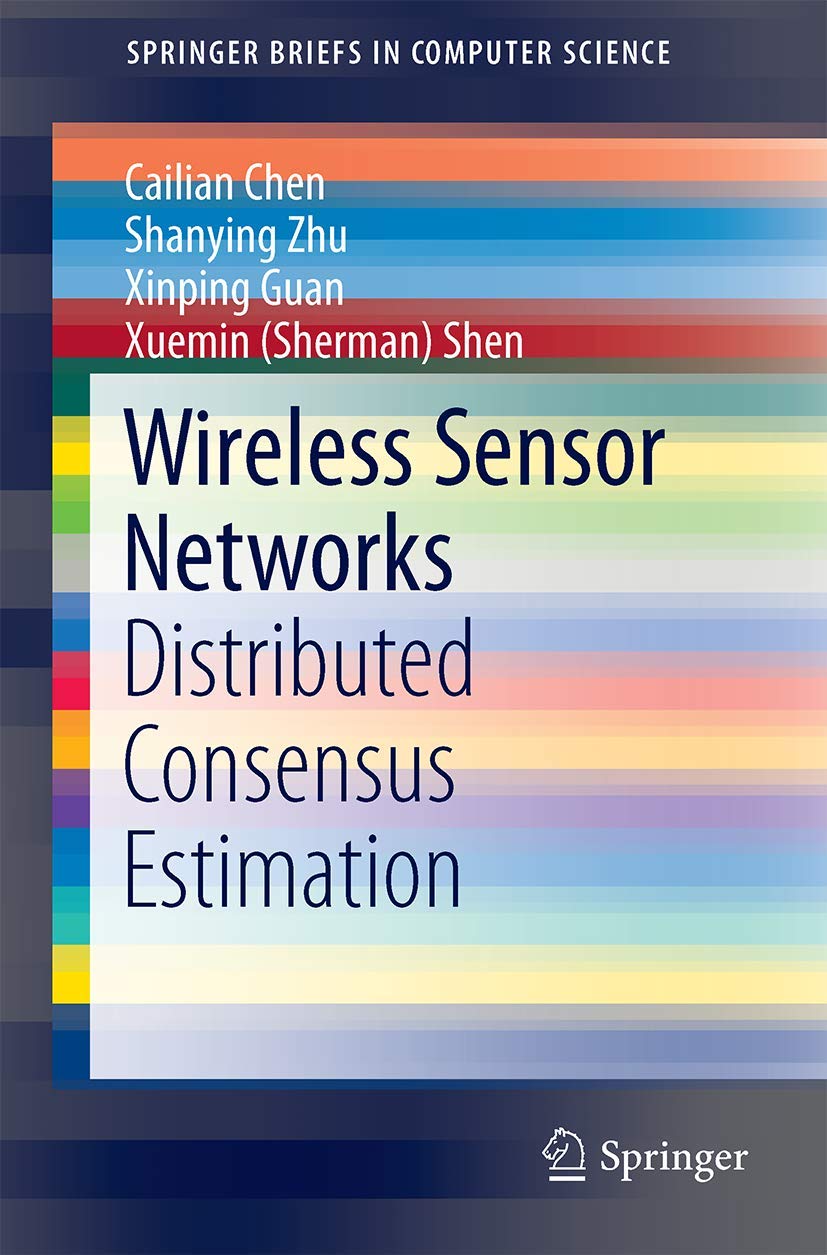
This SpringerBrief evaluates the cooperative effort of sensor nodes to accomplish highlevel tasks with sensing, data processing and communication. The metrics of networkwide convergence, unbiasedness, consistency and optimality are discussed through network topology, distributed estimation algorithms and consensus strategy. Systematic analysis reveals that proper deployment of sensor nodes and a small number of lowcost relays (without sensing function) can speed up the information fusion and thus improve the estimation capability of wireless sensor networks (WSNs). This brief also investigates the spatial distribution of sensor nodes and basic scalable estimation algorithms, the consensusbased estimation capability for a class of relay assisted sensor networks with asymmetric communication topology, and the problem of filter design for mobile target tracking over WSNs. From the system perspective, the network topology is closely related to the capability and efficiency of networkwide scalable distributed estimation. Wireless Sensor Networks: Distributed Consensus Estimation is a valuable resource for researchers and professionals working in wireless communications, networks and distributed computing. Advancedlevel students studying computer science and electrical engineering will also find the content helpful.
⚠️ WARNING (California Proposition 65):
This product may contain chemicals known to the State of California to cause cancer,
birth defects, or other reproductive harm.
For MAP (Minimum Advertised Price) violations and Intellectual Property (IP) or Trademark concerns, please contact:
support@ergodebooks.com
⚠️ California Proposition 65 Warning: Some products sold on this website may expose you to chemicals known to the State of California to cause cancer, birth defects, or other reproductive harm. For more information, visit www.P65Warnings.ca.gov.