If you have any questions, you are always welcome to contact us. We'll get back to you as soon as possible, withing 24 hours on weekdays.
Customer service
All questions about your order, return and delivery must be sent to our customer service team by e-mail at yourstore@yourdomain.com
Sale & Press
If you are interested in selling our products, need more information about our brand or wish to make a collaboration, please contact us at press@yourdomain.com
Help
If you have any questions, you are always welcome to contact us. We'll get back to you as soon as possible, withing 24 hours on weekdays.
Customer service
All questions about your order, return and delivery must be sent to our customer service team by e-mail at yourstore@yourdomain.com
Sale & Press
If you are interested in selling our products, need more information about our brand or wish to make a collaboration, please contact us at press@yourdomain.com
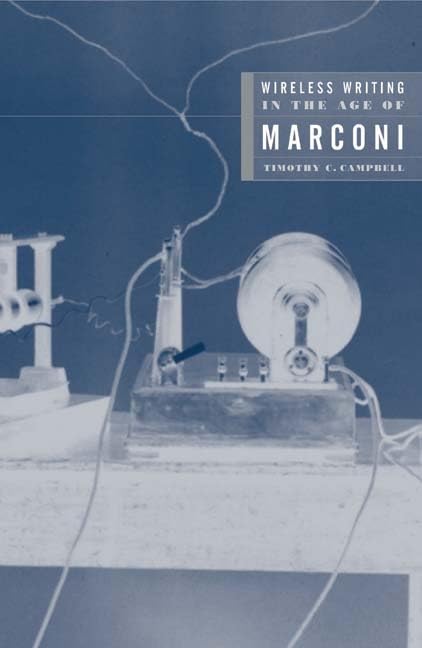
Wireless technology has become deeply embedded in everyday life, but its impact cannot be fully understood without probing the contributions of the Italian inventor Guglielmo Marconi (18741937), who ushered in the beginning of wireless communication. Marconi produced and detected sound waves over long distances, using the curvature of the earth for direction, and laid the foundations for what we know as radiothe original mobile, voiceactivated, and electronic media community.Timothy C. Campbell demonstrates that Marconis invention of the wireless telegraph was not simply a technological act but also had an impact on poetry and aesthetics and linked the written word to the rise of mass politics. Reading influential works such as F. T. Marinettis futurist manifestos, Rudolf Arnheims 1936 study Radio, writings by Gabriele DAnnunzio, and Ezra Pounds Cantos, Campbell reveals how the newness of wireless technology was inscribed in the ways modernist authors engaged with typographical experimentation, apocalyptic tones, and newly minted models for registering voices. Wireless Writing in the Age of Marconi presents an alternative history of modernism that listens as well as looks and bears in mind the altered media environment brought about by the emergence of the wireless.Timothy C. Campbell is associate professor of Italian at Cornell University.
⚠️ WARNING (California Proposition 65):
This product may contain chemicals known to the State of California to cause cancer,
birth defects, or other reproductive harm.
For MAP (Minimum Advertised Price) violations and Intellectual Property (IP) or Trademark concerns, please contact:
support@ergodebooks.com
⚠️ California Proposition 65 Warning: Some products sold on this website may expose you to chemicals known to the State of California to cause cancer, birth defects, or other reproductive harm. For more information, visit www.P65Warnings.ca.gov.