
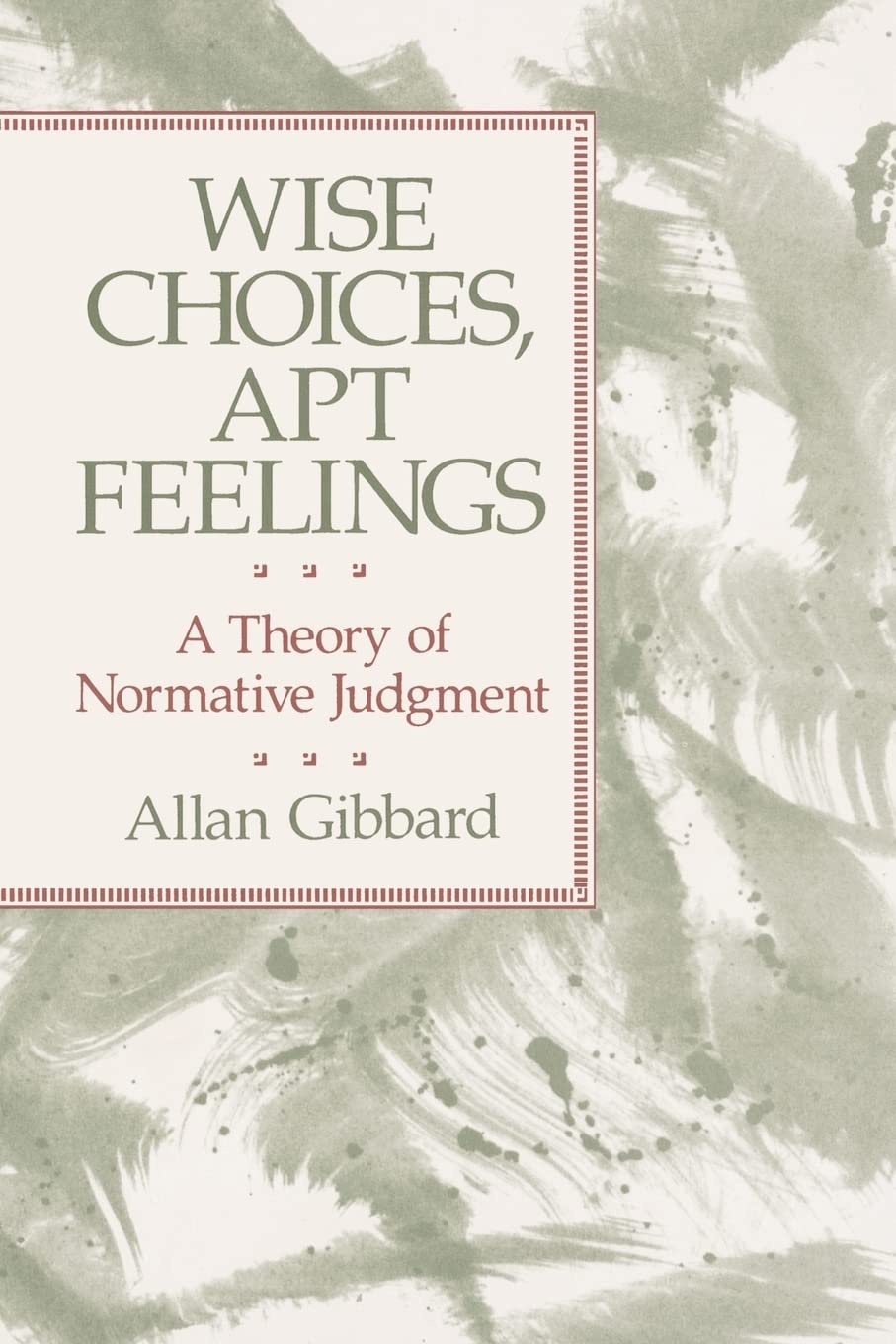
Title
Wise Choices, Apt Feelings: A Theory Of Normative Judgment
Sold by Ergodebooks, an authorized reseller.
Returns accepted within 30 days | support@ergodebooks.com
Shipping Information
- Free Standard Shipping — United States only
- Processing Time: 3–5 business days
- Estimated Delivery: 6–10 business days after dispatch
- Double-boxed, fully insured & discreetly packaged
- Tracking number sent via email once dispatched
Returns & Refund
Returns accepted within 30 days of delivery.
Damaged or Defective Item
Free return shipping + replacement or full refund
Wrong Item Received
Free return shipping + replacement or full refund
Change of Mind
Return shipping at customer's expense · 25% restocking fee applies
Payment Option

This Book Examines Some Of The Deepest Questions In Philosophy: What Is Involved In Judging A Belief, Action, Or Feeling To Be Rational? What Place Does Morality Have In The Kind Of Life It Makes Most Sense To Lead? How Are We To Understand Claims To Objectivity In Moral Judgments And In Judgments Of Rationality? When We Find Ourselves In Fundamental Disagreement With Whole Communities, How Can We Understand Our Disagreement And Cope With It?To Shed Light On Such Issues, Allan Gibbard Develops What He Calls A Normexpressivistic Analysis Of Rationality. He Refines This Analysis By Drawing On Evolutionary Theory And Experimental Psychology, As Well As On More Traditional Moral And Political Philosophy. What Emerges Is An Interpretation Of Human Normative Life, With Its Quandaries And Disputes Over What Is Rational And Irrational, Morally Right And Morally Wrong. Judgments Of What It Makes Sense To Do, To Think, And To Feel, Gibbard Argues, Are Central To Shaping The Way We Live Our Lives.Gibbard Does Not Hesitate To Take Up A Wide Variety Of Possible Difficulties For His Analysis. This Sensitivity To The True Complexity Of The Subject Matter Gives His Treatment A Special Richness And Depth. The Fundamental Importance Of The Issues He Addresses And The Freshness And Suggestiveness Of The Account He Puts Forward, Along With His Illuminating Treatment Of Aspects Of Sociobiology Theory, Will Ensure This Book A Warm Reception From Philosophers, Social Scientists, And Others With A Serious Interest In The Nature Of Human Thought And Action.
⚠️ WARNING (California Proposition 65):
This product may contain chemicals known to the State of California to cause cancer, birth defects, or other reproductive harm.
For more information, please visit www.P65Warnings.ca.gov.
- Q: How many pages does the book have? A: This book has three hundred sixty-four pages. It provides an in-depth exploration of philosophy and normative judgment.
- Q: What is the binding type of the book? A: The book is available in paperback binding. This makes it lightweight and easy to handle.
- Q: What are the dimensions of the book? A: The book measures six point fourteen inches in length, nine point twenty-five inches in height, and zero point ninety-one inches in width.
- Q: How do I read this book effectively? A: To read this book effectively, approach it with an open mind to complex philosophical ideas. Take notes on key arguments to enhance understanding.
- Q: Is this book suitable for beginners in philosophy? A: Yes, this book is suitable for beginners in philosophy. It introduces complex ideas in an accessible manner while challenging the reader.
- Q: What themes does the book cover? A: The book covers themes of rationality, morality, and normative judgment. It also explores disagreements within communities on these topics.
- Q: How should I care for this book? A: To care for this book, store it in a dry place and avoid exposure to direct sunlight. Handle it gently to prevent wear and tear.
- Q: Can I loan this book to others? A: Yes, you can loan this book to others. Just ensure it is returned in good condition to maintain its integrity.
- Q: Is the book safe for all age groups? A: Yes, the book is generally safe for all age groups. However, its content may be more suitable for mature readers due to philosophical complexities.
- Q: What if the book arrives damaged? A: If the book arrives damaged, you should contact the seller for a return or replacement. Most sellers have policies in place for such issues.
- Q: Does the book contain any illustrations or images? A: No, the book does not contain illustrations or images. It focuses primarily on text and philosophical arguments.
- Q: What is the author's background? A: The author, Allan Gibbard, is a respected philosopher known for his work in moral philosophy and normative judgment. His insights are informed by various academic disciplines.
- Q: How does this book compare to others in the same genre? A: This book stands out in the ethics and morality genre due to its unique approach, combining evolutionary theory with philosophical analysis.
- Q: What is the main argument of the book? A: The main argument of the book is that judgments of rationality and morality shape our lives significantly. Gibbard presents a nuanced view of these concepts.
- Q: What if I don’t understand a concept in the book? A: If you don’t understand a concept, consider discussing it with peers or seeking supplementary resources. Engaging with others can clarify complex ideas.