

Title

Without Justification (Bradford Book),Used
Sold by Ergodebooks, an authorized reseller.
Returns accepted within 30 days | support@ergodebooks.com
Shipping Information
- Free Standard Shipping — United States only
- Processing Time: 3–5 business days
- Estimated Delivery: 6–10 business days after dispatch
- Double-boxed, fully insured & discreetly packaged
- Tracking number sent via email once dispatched
Returns & Refund
Returns accepted within 30 days of delivery.
Damaged or Defective Item
Free return shipping + replacement or full refund
Wrong Item Received
Free return shipping + replacement or full refund
Change of Mind
Return shipping at customer's expense · 25% restocking fee applies
Payment Option

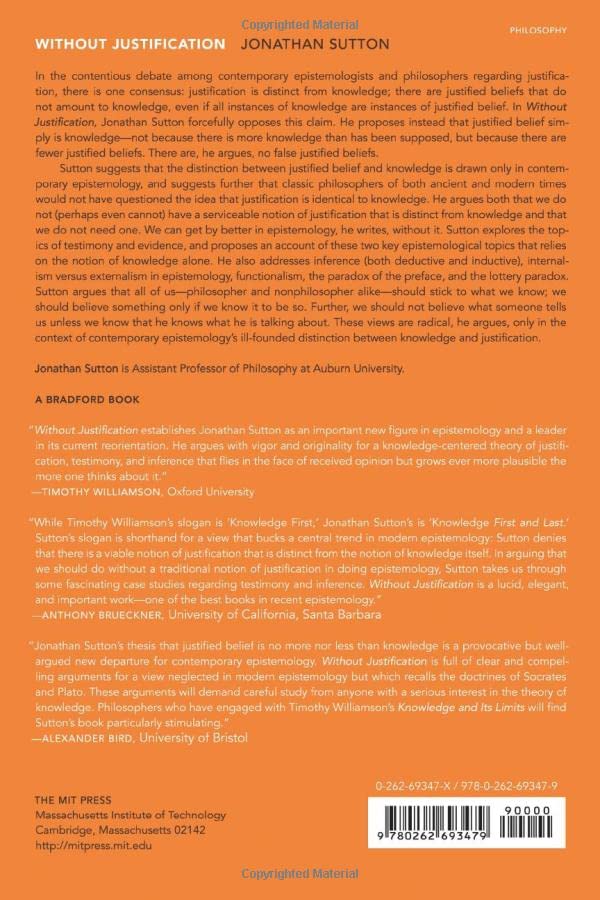
In the contentious debate among contemporary epistemologists and philosophers regarding justification, there is one consensus: justification is distinct from knowledge; there are justified beliefs that do not amount to knowledge, even if all instances of knowledge are instances of justified belief. In Without Justification, Jonathan Sutton forcefully opposes this claim. He proposes instead that justified belief simply is knowledge not because there is more knowledge than has been supposed, but because there are fewer justified beliefs. There are, he argues, no false justified beliefs.Sutton suggests that the distinction between justified belief and knowledge is drawn only in contemporary epistemology, and suggests furter that classic philosophers of both ancient and modern times would not have questioned the idea that justification is identical to knowledge.Sutton argues both that we do not (perhaps even cannot) have a serviceable notion of justification that is distinct from knowledge and that we do not need one. We can get by better in epistemology, he writes, without it. Sutton explores the topics of testimony and evidence, and proposes an account of these two key epistemological topics that relies on the notion of knowledge alone. He also addresses inference (both deductive and inductive), internalism versus externalism in epistemology, functionalism, the paradox of the preface, and the lottery paradox. Sutton argues that all of usphilosopher and nonphilosopher alikeshould stick to what we know; we should believe something only if we know it to be so. Further, we should not believe what someone tells us unless we know that he knows what he is talking about. These views are radical, he argues, only in the context of contemporary epistemology's illfounded distinction between knowledge and justification.
⚠️ WARNING (California Proposition 65):
This product may contain chemicals known to the State of California to cause cancer, birth defects, or other reproductive harm.
For more information, please visit www.P65Warnings.ca.gov.