
Title
Witness to the Truth: My Struggle for Human Rights in Louisiana,Used
Sold by Ergodebooks, an authorized reseller.
Returns accepted within 30 days | support@ergodebooks.com
Shipping Information
- Free Standard Shipping — United States only
- Processing Time: 3–5 business days
- Estimated Delivery: 6–10 business days after dispatch
- Double-boxed, fully insured & discreetly packaged
- Tracking number sent via email once dispatched
Returns & Refund
Returns accepted within 30 days of delivery.
Damaged or Defective Item
Free return shipping + replacement or full refund
Wrong Item Received
Free return shipping + replacement or full refund
Change of Mind
Return shipping at customer's expense · 25% restocking fee applies
Payment Option

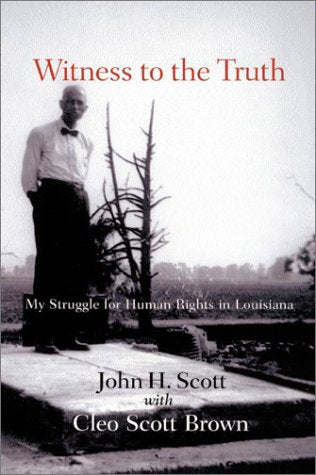
Witness to the Truth tells the extraordinary life story of a grassroots human rights leader and his courageous campaign to win the right to vote for the African Americans of Lake Providence, Louisiana. Born in 1901 in a small, almost allblack parish, John H. Scott grew up in a community where black businesses, schools, and neighborhoods thrived in isolation from the white population. The settlement appeared selfsufficient and independentbut all was not as it seemed. From Reconstruction until the 1960s, African Americans still were not allowed to register and vote. Scott, a minister and farmer, proceeded to redress this inequality. Ultimately convincing Attorney General Robert Kennedy to participate in his crusade, Scott led a twentyfive year struggle that graphically illustrates how persistent efforts by local citizens translated into a national movement.Told in Scott's own words, Witness to the Truth recounts the complex tyranny of southern race relations in Louisiana. Raised by grandparents who lived during slavery, Scott grew up learning about the horrors of that institution, and he himself experienced the injustices of Jim Crow laws. Without bitterness or anger, he chronicles almost one hundred years of life in the parish, including migrations between the two world wars, the displacement of African American farmers during the New Deal, and the shocking methods white southerners used to keep African Americans under economic domination and away from the polls. Chapter president of the National Association for the Advancement of Colored People for more than thirty years and a recipient of the A. P. Tureaud Citizens Award, Scott embodied the persistence, strength, and raw courage required of African American leaders in the rural South, particularly in the 1950s and 1960s. His story illustrates the contributions of local NAACP leaders in advancing the human rights movement.Cleo Scott Brown, Scott's daughter, draws on oral history interviews with her father conducted by historian Joseph Logsdon as the basis for the book. She also uses personal papers, court transcripts, records of the East Carroll chapter of the NAACP, interviews with other East Carroll residents, family recollections, and her own conversations with her father to complete the biography.
⚠️ WARNING (California Proposition 65):
This product may contain chemicals known to the State of California to cause cancer, birth defects, or other reproductive harm.
For more information, please visit www.P65Warnings.ca.gov.