
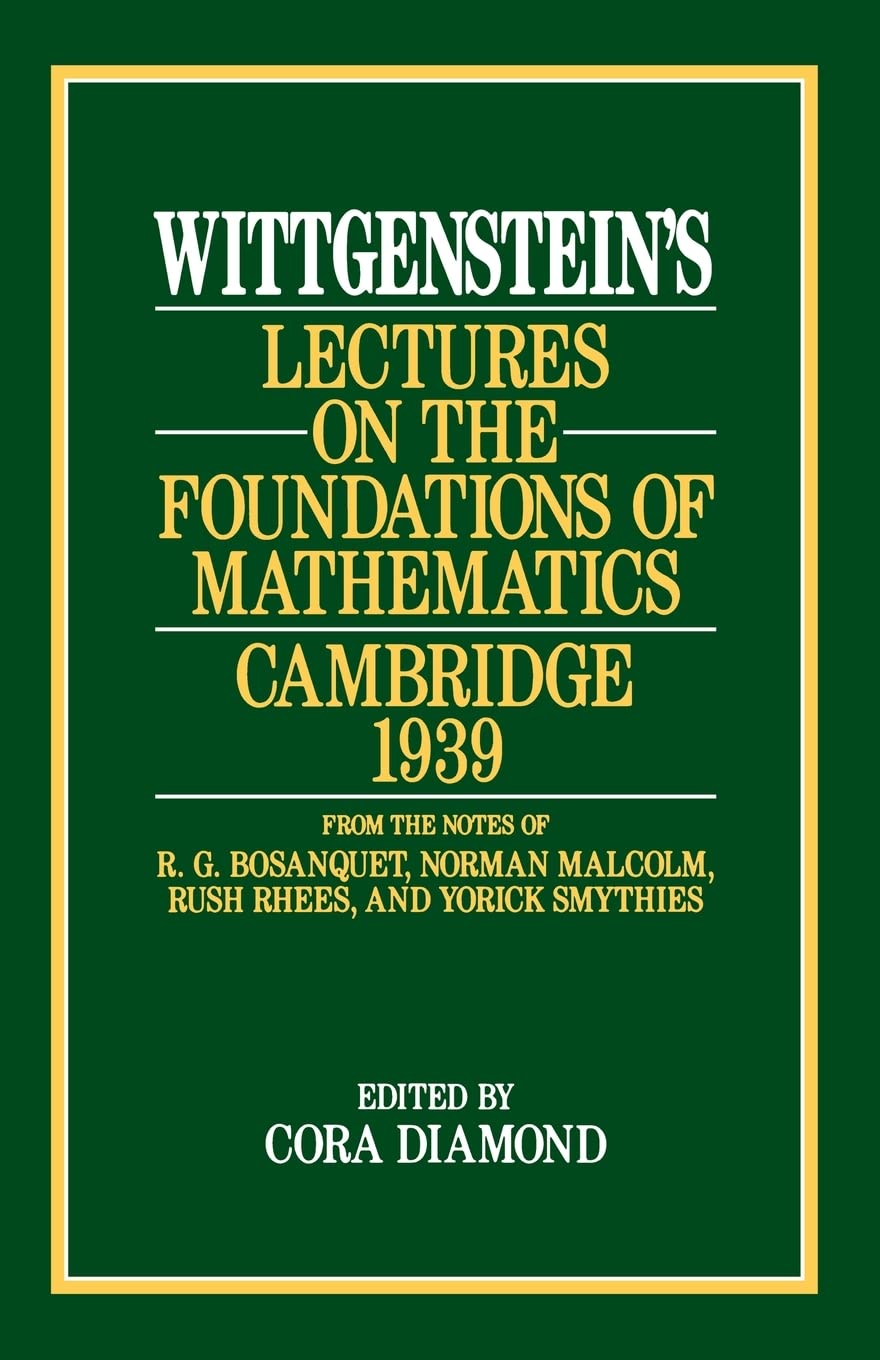
Title
Wittgenstein'S Lectures On The Foundations Of Mathematics, Cambridge, 1939
Sold by Ergodebooks, an authorized reseller.
Returns accepted within 30 days | support@ergodebooks.com
Shipping Information
- Free Standard Shipping — United States only
- Processing Time: 3–5 business days
- Estimated Delivery: 6–10 business days after dispatch
- Double-boxed, fully insured & discreetly packaged
- Tracking number sent via email once dispatched
Returns & Refund
Returns accepted within 30 days of delivery.
Damaged or Defective Item
Free return shipping + replacement or full refund
Wrong Item Received
Free return shipping + replacement or full refund
Change of Mind
Return shipping at customer's expense · 25% restocking fee applies
Payment Option

For Several Terms At Cambridge In 1939, Ludwig Wittgenstein Lectured On The Philosophical Foundations Of Mathematics. A Lecture Class Taught By Wittgenstein, However, Hardly Resembled A Lecture.He Sat On A Chair In The Middle Of The Room, With Some Of The Class Sitting In Chairs, Some On The Floor. He Never Used Notes. He Paused Frequently, Sometimes For Several Minutes, While He Puzzled Out A Problem. He Often Asked His Listeners Questions And Reacted To Their Replies. Many Meetings Were Largely Conversation.These Lectures Were Attended By, Among Others, D. A. T. Gasking, J. N. Findlay, Stephen Toulmin, Alan Turing, G. H. Von Wright, R. G. Bosanquet, Norman Malcolm, Rush Rhees, And Yorick Smythies. Notes Taken By These Last Four Are The Basis For The Thirtyone Lectures In This Book.The Lectures Covered Such Topics As The Nature Of Mathematics, The Distinctions Between Mathematical And Everyday Languages, The Truth Of Mathematical Propositions, Consistency And Contradiction In Formal Systems, The Logicism Of Frege And Russell, Platonism, Identity, Negation, And Necessary Truth. The Mathematical Examples Used Are Nearly Always Elementary.
⚠️ WARNING (California Proposition 65):
This product may contain chemicals known to the State of California to cause cancer, birth defects, or other reproductive harm.
For more information, please visit www.P65Warnings.ca.gov.
- Q: How many pages does this book have? A: This book has three hundred pages. It offers an extensive exploration of the philosophical foundations of mathematics.
- Q: What is the binding style of this book? A: The book is available in paperback binding. This makes it lightweight and easy to handle for reading.
- Q: What are the dimensions of this book? A: The book measures five point five one inches in length, zero point eight inches in width, and eight point five inches in height. These dimensions make it portable and easy to store.
- Q: Who is the author of this book? A: The author of this book is Ludwig Wittgenstein. He is renowned for his contributions to philosophy, particularly in logic and mathematics.
- Q: What topics are covered in this book? A: The book covers topics such as the nature of mathematics and the distinctions between mathematical and everyday languages. It also discusses the truth of mathematical propositions and the logicism of Frege and Russell.
- Q: Is this book suitable for beginners in philosophy? A: Yes, this book is suitable for beginners. It presents complex ideas in an engaging conversational format, making them accessible.
- Q: What is the reading level of this book? A: The reading level is appropriate for college students and above. The philosophical discussions require some foundational knowledge of mathematics and logic.
- Q: How can I best engage with the content of this book? A: To engage with the content, consider taking notes during reading. Reflect on the discussions and try to answer Wittgenstein's questions for deeper understanding.
- Q: Are there any recommendations for studying this book effectively? A: Yes, it is recommended to study this book in a group. Discussing the lectures with others can enhance comprehension and provide different perspectives.
- Q: How should I store this book to keep it in good condition? A: Store this book upright on a shelf. Ensure it is kept away from direct sunlight and moisture to prevent damage.
- Q: Can this book be used as a reference for academic work? A: Yes, this book can be used as a reference for academic work. It is a significant text in the philosophy of mathematics and often cited in scholarly discussions.
- Q: What if the book arrives damaged? A: If the book arrives damaged, you can request a replacement or refund. Check the return policy of the retailer for specific instructions.
- Q: Is there a warranty on this book? A: No, there is typically no warranty on books. However, most retailers offer return policies for damaged or unsatisfactory items.
- Q: Are there any additional resources to accompany this book? A: Yes, supplementary resources such as lecture notes and recordings from Wittgenstein's classes can enhance understanding. Check academic databases or libraries for access.
- Q: Is this book appropriate for a casual reader? A: Yes, casual readers may find this book interesting. Its conversational style can appeal to those curious about philosophy, even without a formal background.