If you have any questions, you are always welcome to contact us. We'll get back to you as soon as possible, withing 24 hours on weekdays.
Customer service
All questions about your order, return and delivery must be sent to our customer service team by e-mail at yourstore@yourdomain.com
Sale & Press
If you are interested in selling our products, need more information about our brand or wish to make a collaboration, please contact us at press@yourdomain.com
Help
If you have any questions, you are always welcome to contact us. We'll get back to you as soon as possible, withing 24 hours on weekdays.
Customer service
All questions about your order, return and delivery must be sent to our customer service team by e-mail at yourstore@yourdomain.com
Sale & Press
If you are interested in selling our products, need more information about our brand or wish to make a collaboration, please contact us at press@yourdomain.com
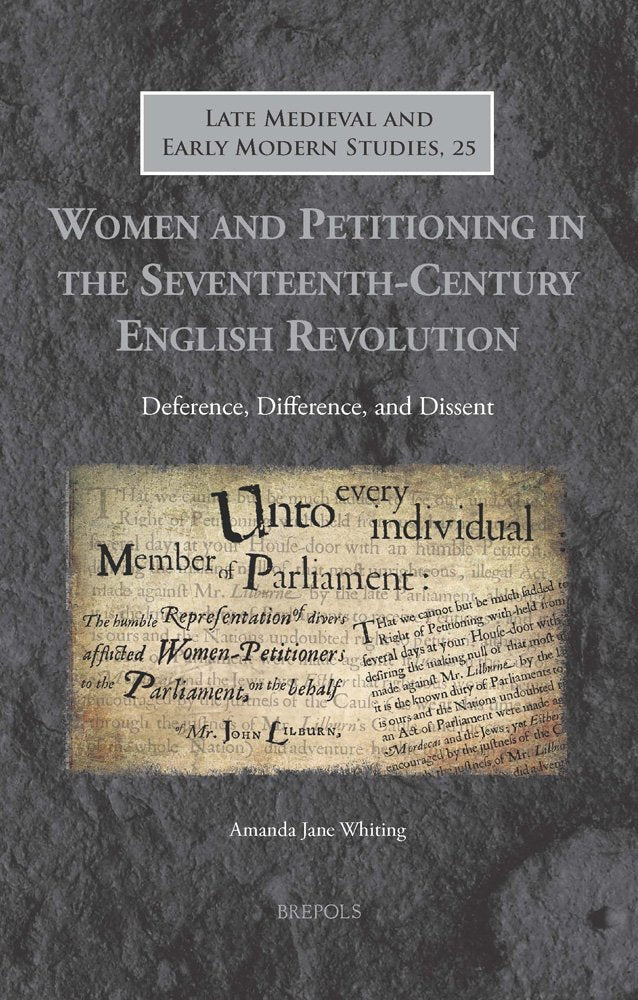
During the English Civil Wars and Revolution (164060), the affairs of Church and State came under a crucial new form of comment and critique, in the form of public petitions. Petitioning was a readily available mode of communication for women, and this study explores the ways in which petitioning in seventeenthcentury England was adapted out of and differed from preRevolutionary modes, whilst also highlighting gendered conventions and innovations of petitioning in that period. Male petitioning in the seventeenth century did not have to negotiate the cultural assumptions about intellectual inferiority and legal incapacity that constrained women. Yet just because women did not claim separate (and modern) women's rights does not mean that they were passive, quiescent, or had no political agency. On the contrary, as this study shows, women in the Revolution could use petitioning as a powerful way to address those in power, precisely because it was done from an assumed position of weakness. The petition is not simply a text, authored by a single pen, but a series of social transactions, performed in multiple social and political settings, frequently involving people previously excluded from participation in political discussion or action. To the extent that women participated in collective petitioning, or turned their individual addresses into printed artefacts for public scrutiny, they also participated in the public sphere of political opinion and debate.
⚠️ WARNING (California Proposition 65):
This product may contain chemicals known to the State of California to cause cancer,
birth defects, or other reproductive harm.
For MAP (Minimum Advertised Price) violations and Intellectual Property (IP) or Trademark concerns, please contact:
support@ergodebooks.com
⚠️ California Proposition 65 Warning: Some products sold on this website may expose you to chemicals known to the State of California to cause cancer, birth defects, or other reproductive harm. For more information, visit www.P65Warnings.ca.gov.