
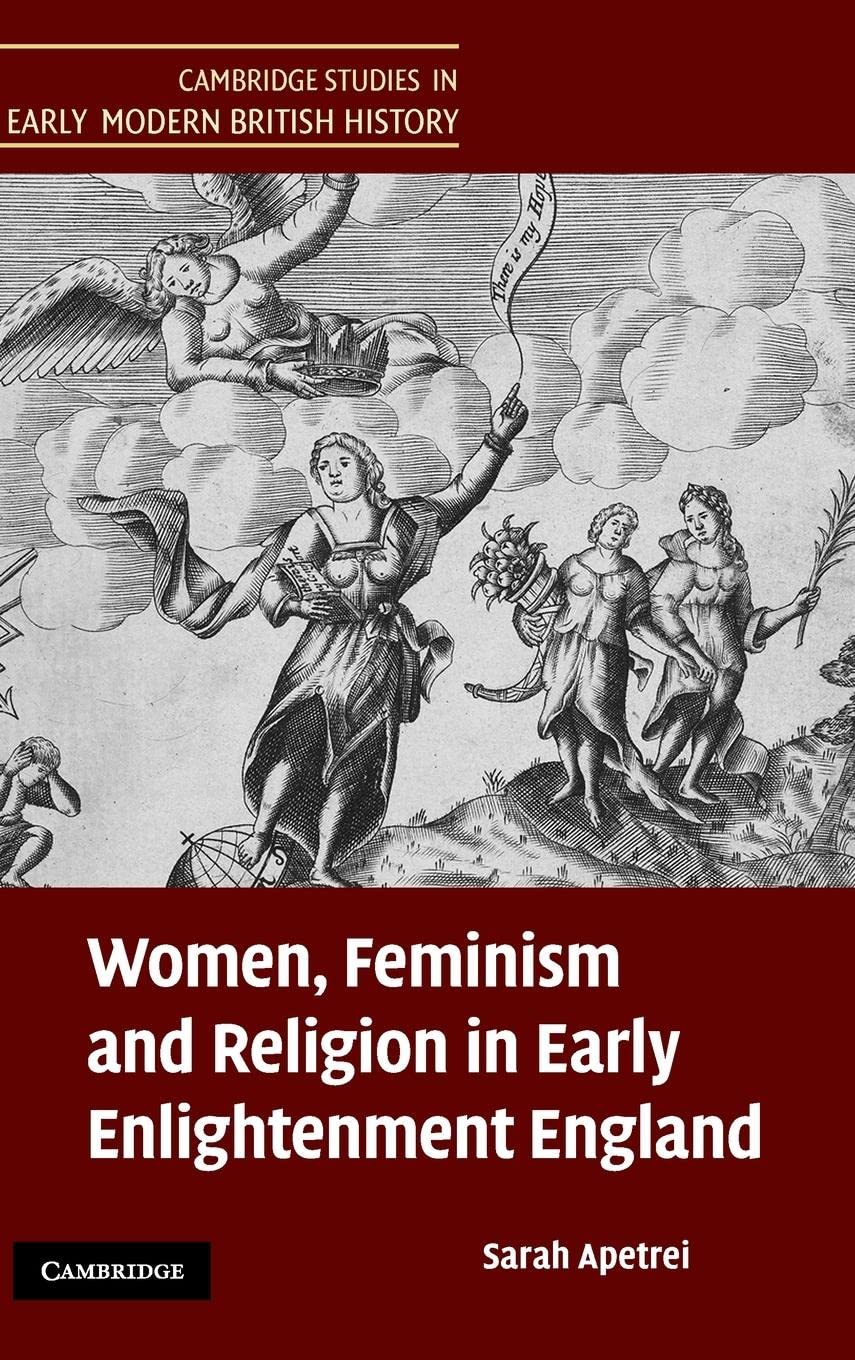
Title
Women, Feminism And Religion In Early Enlightenment England (Cambridge Studies In Early Modern British History)
Sold by Ergodebooks, an authorized reseller.
Returns accepted within 30 days | support@ergodebooks.com
Shipping Information
- Free Standard Shipping — United States only
- Processing Time: 3–5 business days
- Estimated Delivery: 6–10 business days after dispatch
- Double-boxed, fully insured & discreetly packaged
- Tracking number sent via email once dispatched
Returns & Refund
Returns accepted within 30 days of delivery.
Damaged or Defective Item
Free return shipping + replacement or full refund
Wrong Item Received
Free return shipping + replacement or full refund
Change of Mind
Return shipping at customer's expense · 25% restocking fee applies
Payment Option

Illuminating A Formative Period In The Debate Over Sexual Difference, This Book Contributes To Our Understanding Of The Origins Of Feminist Thought. In Late Seventeenthcentury England, Female Writers From Diverse Religious And Political Traditions Confronted The Question Of Women'S Subordination. Their Feminist Protests Disturbed Even Those Who Championed Women'S Education And Defended Female Virtue. Some Of These Women, Including Lady Mary Chudleigh And The Tory Feminist Mary Astell, Have Attracted Interest For Their Literary Achievements And Philosophical Originality. This Book Approaches Them From A New Perspective, Arguing That The Primary Impulse For Their Feminism Was Religious Reformism: Manifest In Personal Devotion, Serious Theological Reflection And A Vision For Moral Renewal And Social Justice. This Reforming Feminism, Sarah Apetrei Argues, Links Astell To The Assertive Women Of Dissenting And Spiritualist Traditions. Far From Being A Constraining Influence On Feminism, Religion Was A Stimulus To New Thinking About The Status Of Women.
⚠️ WARNING (California Proposition 65):
This product may contain chemicals known to the State of California to cause cancer, birth defects, or other reproductive harm.
For more information, please visit www.P65Warnings.ca.gov.
- Q: How many pages does this book have? A: This book has three hundred thirty-six pages. It provides an in-depth exploration of feminism and religion in early Enlightenment England.
- Q: What are the dimensions of the book? A: The book measures six point twenty-six inches in length, zero point seventy-five inches in width, and nine point twenty-five inches in height. These dimensions make it a convenient size for reading and storage.
- Q: What type of binding does the book have? A: The book is bound in hardcover. This durable binding ensures longevity and protection for the pages inside.
- Q: Who is the author of this book? A: The author of this book is Sarah Apetrei. She explores the connections between feminism and religious reformism during the Enlightenment.
- Q: What is the main theme of the book? A: The main theme of the book is the intersection of feminism and religion in early Enlightenment England. It discusses how female writers challenged societal norms.
- Q: What historical period does this book cover? A: This book covers the late seventeenth-century period in England. It focuses on the early debates surrounding women's rights and roles in society.
- Q: How does this book approach feminist thought? A: This book approaches feminist thought by examining the religious motivations behind women's subordination. It highlights how these motivations influenced feminist protests.
- Q: Is this book suitable for academic study? A: Yes, this book is suitable for academic study. It contributes significantly to the understanding of feminist thought and historical perspectives.
- Q: Who would benefit from reading this book? A: Scholars, students, and anyone interested in feminism, religion, and early modern history would benefit from this book. It offers unique insights into women's roles.
- Q: Does the book include any notable figures? A: Yes, the book discusses notable figures such as Lady Mary Chudleigh and Mary Astell. Their contributions to feminist thought are examined in detail.
- Q: What is the primary argument of the book? A: The primary argument of the book is that religious reformism was a significant driving force behind early feminist thought. It connects religion with social justice themes.
- Q: How does the author link religion to feminism? A: The author links religion to feminism by arguing that religious beliefs motivated women's advocacy for rights and moral renewal. This connection is explored throughout the text.
- Q: What type of audience is this book intended for? A: This book is intended for readers interested in gender studies, history, and religious studies. It is suitable for both general readers and academics.
- Q: Are there any specific themes explored regarding women's roles? A: Yes, the book explores themes of subordination, education, and virtue in relation to women's roles in society during the Enlightenment.
- Q: What publisher released this book? A: This book was published by Cambridge University Press. The publisher is known for its scholarly contributions to various fields.
- Q: Can this book be used for reference in research projects? A: Yes, this book can be used as a reference in research projects. Its comprehensive analysis provides valuable insights into feminist history.