
Title
Women's Activism, Feminism, and Social Justice (Studies in Feminist Philosophy),Used
Sold by Ergodebooks, an authorized reseller.
Returns accepted within 30 days | support@ergodebooks.com
Shipping Information
- Free Standard Shipping — United States only
- Processing Time: 3–5 business days
- Estimated Delivery: 6–10 business days after dispatch
- Double-boxed, fully insured & discreetly packaged
- Tracking number sent via email once dispatched
Returns & Refund
Returns accepted within 30 days of delivery.
Damaged or Defective Item
Free return shipping + replacement or full refund
Wrong Item Received
Free return shipping + replacement or full refund
Change of Mind
Return shipping at customer's expense · 25% restocking fee applies
Payment Option

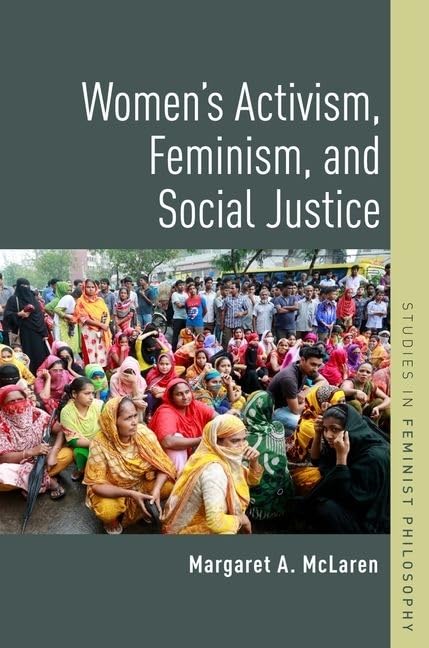
A wide range of issues besieges women globally, including economic exploitation, sexist oppression, racial, ethnic, and caste oppression, and cultural imperialism. This book builds a feminist social justice framework from practices of women's activism in India to understand and work to overcome these injustices. The feminist social justice framework provides an alternative to mainstream philosophical frameworks that promote global gender justice: for example, universal human rights, economic projects such as microfinance, and cosmopolitanism. McLaren demonstrates that these frameworks are bound by a commitment to individualism and an abstract sense of universalism that belies their root neoliberalism. Arguing that these frameworks emphasize individualism over interdependence, similarity over diversity, and individual success over collective capacity, McLaren draws on the work of Rabindranath Tagore to develop the concept of relational cosmopolitanism.Relational cosmopolitanism prioritizes our connections while, crucially, acknowledging the reality of power differences. Extending Iris Young's theory of political responsibility, McLaren shows how Fair Trade connects to the economic solidarity movement. The SelfEmployed Women's Association and MarketPlace India empower women through access to livelihoods as well as fostering leadership capabilities that allow them to challenge structural injustice through political and social activism. Their struggles to resist economic exploitation and gender oppression through collective action show the vital importance of challenging individualist approaches to achieving gender justice. The book is a rallying call for a shift in our thinking and practice towards reimagining the possibilities for justice from a relational framework, from independence to interdependence, from identity to intersectionality, and from interest to sociopolitical imagination.
⚠️ WARNING (California Proposition 65):
This product may contain chemicals known to the State of California to cause cancer, birth defects, or other reproductive harm.
For more information, please visit www.P65Warnings.ca.gov.
- Q: What is the main focus of 'Women's Activism, Feminism, and Social Justice'? A: The book focuses on building a feminist social justice framework through the lens of women's activism in India, addressing various global issues faced by women such as economic exploitation and cultural imperialism.
- Q: Who is the author of this book? A: The author of 'Women's Activism, Feminism, and Social Justice' is Margaret A. McLaren.
- Q: When was the book published? A: The book was published on September 12, 2019.
- Q: What is the binding type of this book? A: The book is available in paperback binding.
- Q: How many pages does the book have? A: The book contains 290 pages.
- Q: What category does this book fall under? A: This book falls under the category of Human Rights.
- Q: What is the condition of the book being sold? A: The book is in new condition.
- Q: Does the book discuss modern feminist frameworks? A: Yes, the book critiques mainstream feminist frameworks and promotes an alternative approach emphasizing interdependence and collective action.
- Q: Is this book suitable for academic study? A: Yes, the book is suitable for academic study, particularly in feminist philosophy and social justice courses.
- Q: What key themes are explored in the book? A: Key themes include economic solidarity, relational cosmopolitanism, and the importance of collective action in achieving gender justice.