
Title
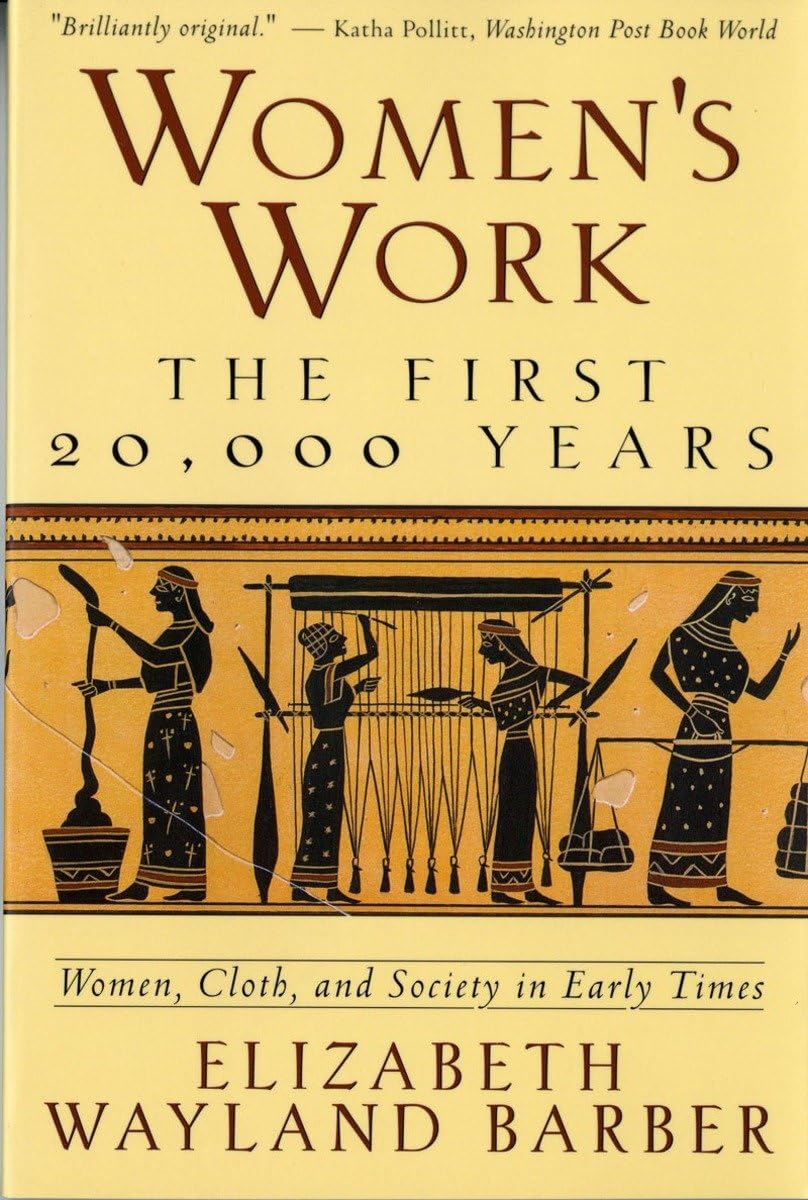
Women's Work: The First 20,000 Years Women, Cloth, and Society in Early Times,New
Sold by Ergodebooks, an authorized reseller.
Returns accepted within 30 days | support@ergodebooks.com
Shipping Information
- Free Standard Shipping — United States only
- Processing Time: 3–5 business days
- Estimated Delivery: 6–10 business days after dispatch
- Double-boxed, fully insured & discreetly packaged
- Tracking number sent via email once dispatched
Returns & Refund
Returns accepted within 30 days of delivery.
Damaged or Defective Item
Free return shipping + replacement or full refund
Wrong Item Received
Free return shipping + replacement or full refund
Change of Mind
Return shipping at customer's expense · 25% restocking fee applies
Payment Option

A fascinating history of[a craft] that preceded and made possible civilization itself.' New York Times Book Review New discoveries about the textile arts reveal women's unexpectedly influential role in ancient societies.Twenty thousand years ago, women were making and wearing the first clothing created from spun fibers. In fact, right up to the Industrial Revolution the fiber arts were an enormous economic force, belonging primarily to women.Despite the great toil required in making cloth and clothing, most books on ancient history and economics have no information on them. Much of this gap results from the extreme perishability of what women produced, but it seems clear that until now descriptions of prehistoric and early historic cultures have omitted virtually half the picture.Elizabeth Wayland Barber has drawn from data gathered by the most sophisticated new archaeological methodsmethods she herself helped to fashion. In a 'brilliantly original book' (Katha Pollitt, Washington Post Book World), she argues that women were a powerful economic force in the ancient world, with their own industry: fabric.
⚠️ WARNING (California Proposition 65):
This product may contain chemicals known to the State of California to cause cancer, birth defects, or other reproductive harm.
For more information, please visit www.P65Warnings.ca.gov.
- Q: What is the main theme of 'Women's Work: The First 20,000 Years'? A: The book explores the significant role women played in the textile arts and their economic influence in ancient societies, highlighting their contributions to civilization through the production of clothing and fabric.
- Q: Who is the author of this book? A: The author is Elizabeth Wayland Barber, an expert in textile history and archaeology.
- Q: How many pages does this book have? A: This book contains 336 pages.
- Q: What is the binding type of the book? A: The book is available in paperback binding.
- Q: When was 'Women's Work: The First 20,000 Years' published? A: The book was published on January 1, 1996.
- Q: Is this book suitable for academic research? A: Yes, the book is well-researched and draws from new archaeological methods, making it a valuable resource for academic studies in history and women's contributions.
- Q: What topics does the book cover? A: The book covers topics such as the history of textile arts, women's roles in ancient economies, and the cultural significance of fabric production throughout history.
- Q: Is there any information on the historical context of the textile arts? A: Yes, the book provides insights into the historical context of the textile arts and discusses how women's work in this field shaped early civilizations.
- Q: What makes this book unique compared to other history books? A: This book uniquely focuses on women's contributions to the textile arts, an often overlooked aspect of history, providing a more comprehensive understanding of ancient societies.
- Q: Can this book be a good gift for someone interested in women's history? A: Absolutely, it offers a fascinating perspective on women's roles in history and would be an excellent gift for those interested in women's studies or history.