If you have any questions, you are always welcome to contact us. We'll get back to you as soon as possible, withing 24 hours on weekdays.
Customer service
All questions about your order, return and delivery must be sent to our customer service team by e-mail at yourstore@yourdomain.com
Sale & Press
If you are interested in selling our products, need more information about our brand or wish to make a collaboration, please contact us at press@yourdomain.com
Help
If you have any questions, you are always welcome to contact us. We'll get back to you as soon as possible, withing 24 hours on weekdays.
Customer service
All questions about your order, return and delivery must be sent to our customer service team by e-mail at yourstore@yourdomain.com
Sale & Press
If you are interested in selling our products, need more information about our brand or wish to make a collaboration, please contact us at press@yourdomain.com
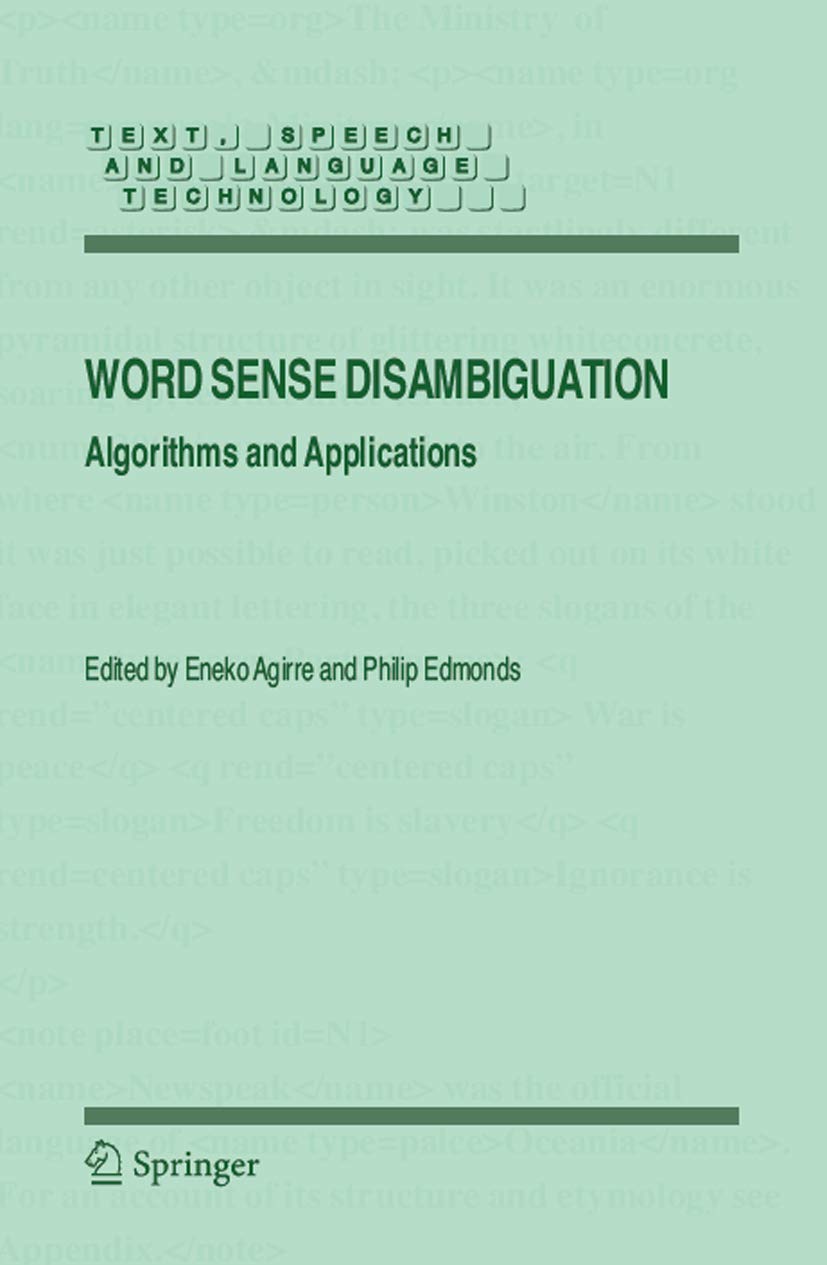
Graeme Hirst University of Toronto Of the many kinds of ambiguity in language, the two that have received the most attention in computational linguistics are those of word senses and those of syntactic structure, and the reasons for this are clear: these ambiguities are overt, their resolution is seemingly essential for any prac cal application, and they seem to require a wide variety of methods and knowledgesources with no pattern apparent in what any particular stance requires. Right at the birth of artificial intelligence, in his 1950 paper Computing machinery and intelligence, Alan Turing saw the ability to understand language as an essential test of intelligence, and an essential test of l guage understanding was an ability to disambiguate; his example involved deciding between the generic and specific readings of the phrase a winters day. The first generations of AI researchers found it easy to construct amples of ambiguities whose resolution seemed to require vast knowledge and deep understanding of the world and complex inference on this kno edge; for example, Pharmacists dispense with accuracy. The disambig tion problem was, in a way, nothing less than the artificial intelligence problem itself. No use was seen for a disambiguation method that was less than 100% perfect; either it worked or it didnt. Lexical resources, such as they were, were considered secondary to nonlinguistic commonsense knowledge of the world.
⚠️ WARNING (California Proposition 65):
This product may contain chemicals known to the State of California to cause cancer,
birth defects, or other reproductive harm.
For MAP (Minimum Advertised Price) violations and Intellectual Property (IP) or Trademark concerns, please contact:
support@ergodebooks.com
⚠️ California Proposition 65 Warning: Some products sold on this website may expose you to chemicals known to the State of California to cause cancer, birth defects, or other reproductive harm. For more information, visit www.P65Warnings.ca.gov.