
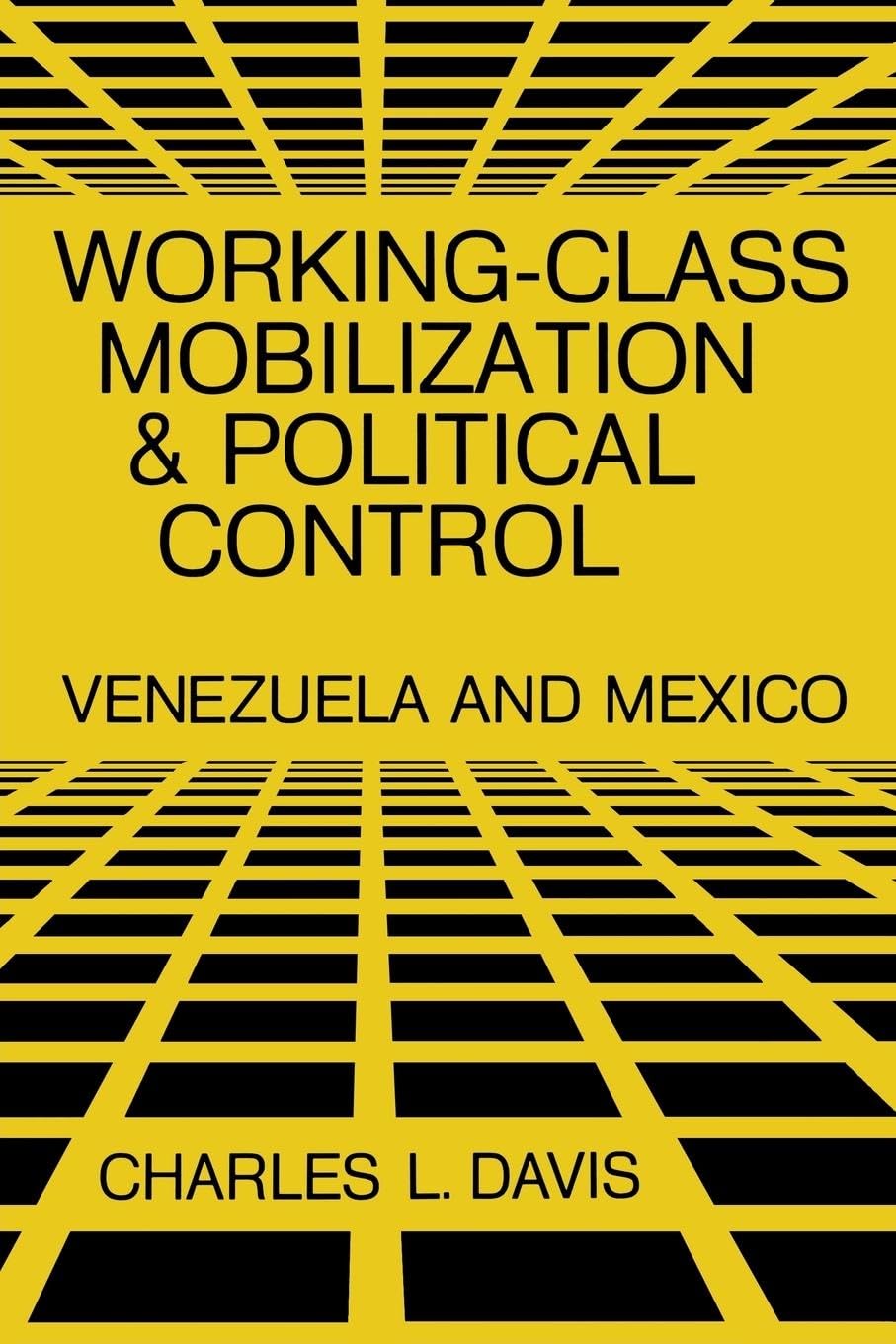
Title
Workingclass Mobilization And Political Control: Venezuela And Mexico,Used
Sold by Ergodebooks, an authorized reseller.
Returns accepted within 30 days | support@ergodebooks.com
Shipping Information
- Free Standard Shipping — United States only
- Processing Time: 3–5 business days
- Estimated Delivery: 6–10 business days after dispatch
- Double-boxed, fully insured & discreetly packaged
- Tracking number sent via email once dispatched
Returns & Refund
Returns accepted within 30 days of delivery.
Damaged or Defective Item
Free return shipping + replacement or full refund
Wrong Item Received
Free return shipping + replacement or full refund
Change of Mind
Return shipping at customer's expense · 25% restocking fee applies
Payment Option

Historically, Latin American political regimes have sought to postpone farreaching economic reforms and improvements in living standards in order to facilitate the accumulation of private capital. These goals have led to exclusion of the lower classes from the political process altogether or to efforts to control their political mobilization. The ability of governments to maintain such control has often been attributed to the lack of political sophistication by the working class or to the distribution of benefits through patronclient networks designed to preserve the hegemony of ruling parties.Using new survey data from 500 industrial workers in Mexico and Venezuela, Charles L. Davis now questions these conventional explanations and two others: that industrial workers are part of a 'labor aristocracy' and are therefore content with the performance of the capitalist regimes, and that political control is exercised through restriction of partisan competition and thus of opportunities for workers to challenge developmental priorities and public policy goals.Davis's study demonstrates that workingclass mobilization is more firmly controlled in Mexico's oneparty dominant political system than in Venezuela's twoparty system. He finds little evidence that political participation in either country is guided by labor unions with ties to dominant parties. Nor are these workers content with the performance of the regimes or lacking in political sophistication. The primary explanation for their psychological disengagement from politics and avoidance of protest voting appears to be the lack of meaningful electoral options.Davis's two case studies provide important new insights into an issue that appears certain to remain explosive as dissident labor leaders in Latin America seek to mobilize workingclass opposition to existing state developmental strategies.
⚠️ WARNING (California Proposition 65):
This product may contain chemicals known to the State of California to cause cancer, birth defects, or other reproductive harm.
For more information, please visit www.P65Warnings.ca.gov.