
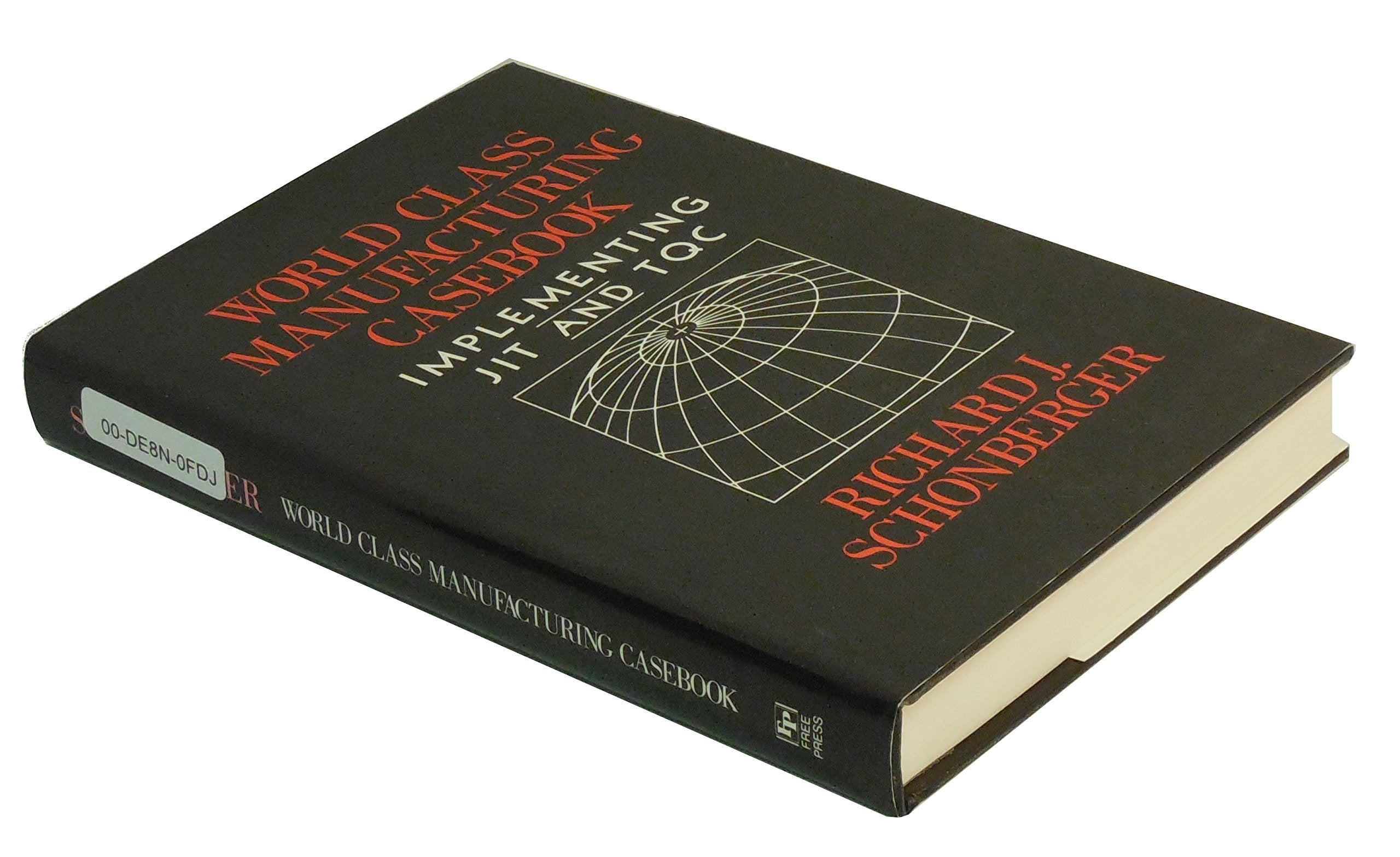
Title
World Class Manufacturing: The Lessons Of Simplicity Applied-used
Sold by Ergodebooks, an authorized reseller.
Returns accepted within 30 days | support@ergodebooks.com
Shipping Information
- Free Standard Shipping — United States only
- Processing Time: 3–5 business days
- Estimated Delivery: 6–10 business days after dispatch
- Double-boxed, fully insured & discreetly packaged
- Tracking number sent via email once dispatched
Returns & Refund
Returns accepted within 30 days of delivery.
Damaged or Defective Item
Free return shipping + replacement or full refund
Wrong Item Received
Free return shipping + replacement or full refund
Change of Mind
Return shipping at customer's expense · 25% restocking fee applies
Payment Option

In His Bestselling Book Japanese Manufacturing Techniques, Richard J. Schonberger Revolutionized American Manufacturing Theory And, More Important, Practice. In That Breakthrough Book, He Revealed That Japanese Manufacturing Excellence Was Not Culturally Bound. Offering The First Demystified Explanation Of The Simple Techniques That Fueled Japans Industrial Success, He Demonstrated How The Same Methods Could Be Put To Work As Effectively In U.S. Plants. Now, In World Class Manufacturing, Schonberger Returns To Tell The Success Stories Of Nearly 100 American Corporations Including Hewlettpackard, Harleydavidson, General Motors, Honeywell, And Uniroyal That Have Adopted The Famed Justintime Production And 'Total Quality Control' Strategies. Based On His Firsthand Experience As A Major Consultant To American Industry, He Examines How They Did It And Illustrates How The Same Concrete, Specific Steps Used By These Top Companies Can Be Implemented In Any Factory Today. Whats More, Schonberger Shows That His Bold Concepts And Reforms Apply Equally To All Industries, Whether The Product Is Computers, Pasta, Or Trucks, And To All Divisions From Manufacturing And Engineering To Accounting And Marketing. According To Schonberger, Worldclass Manufacturing Depends On Blended Management Rather Than Domination By A Separate Group Of Managers Which Marshalls Resources For Continual Rapid Improvement. To Achieve Worldclass Status, Companies Must Change Procedures And Concepts, Which In Turn Leads To Recasting Relations Among Suppliers, Purchasers, Producers, And Customers. Acknowledging The Difficulty Inherent In Such Changes, Schonberger Stresses That Employee Involvement And Interaction, Both On The Shop Floor And In The Decisionmaking/Problemsolving Process, Is Key. Wary Of Those Who View Improvement In Terms Of Modernizing Equipment, He Points Out That Making Maximum Use Of People And Current Machinery Is A Companys First Priority; Automation, If Necessary, Should Come Much Later. World Class Manufacturing Also Includes Schonbergers 17Point Action Agenda To Guide Innovators Toward Manufacturing Excellence, From Getting To Know The Customer To Cutting The Number Of Suppliers, Reducing Error In Production, And Deciding When And How To Automate. Indispensable For All Manufacturing Innovators Who Aim To Keep Ahead Of The Competition, This Inspiring, Groundbreaking Volume Does Much More Than Just Recommend Or Theorize About The New Manufacturing Approach. Plainly, Realistically, And Logically, It Explains How Its Done.
⚠️ WARNING (California Proposition 65):
This product may contain chemicals known to the State of California to cause cancer, birth defects, or other reproductive harm.
For more information, please visit www.P65Warnings.ca.gov.
- Q: How many pages does the book have? A: The book contains two hundred fifty-three pages. This length provides a comprehensive exploration of manufacturing techniques and practices.
- Q: What is the binding type of this book? A: The book is hardcover. This binding style enhances durability and makes it suitable for frequent use.
- Q: What are the dimensions of the book? A: The book measures six point thirty-four inches in length, zero point ninety-eight inches in width, and nine point fifty-eight inches in height. These dimensions make it easy to handle and store.
- Q: Who is the author of this book? A: The author is Richard J. Schonberger. He is known for his expertise in manufacturing techniques and has written several influential books on the subject.
- Q: What is the main focus of the book? A: The book focuses on manufacturing excellence and the application of Japanese techniques in American industry. It includes success stories from nearly one hundred companies.
- Q: Is this book suitable for beginners in manufacturing? A: Yes, the book is suitable for beginners. It provides clear explanations of manufacturing concepts and actionable steps for improvement.
- Q: Can this book help improve manufacturing processes? A: Yes, it offers practical strategies for enhancing manufacturing processes. The author shares proven methods used by successful companies.
- Q: Is there a specific audience this book targets? A: The book targets professionals in manufacturing and management roles. It is also valuable for students studying industrial engineering.
- Q: Does the book include case studies? A: Yes, the book includes case studies of nearly one hundred American corporations. These real-world examples illustrate the application of the discussed techniques.
- Q: How does the author suggest improving employee involvement? A: The author emphasizes the importance of employee involvement on the shop floor. He advocates for interaction in decision-making and problem-solving processes.
- Q: What is the main theme of the book? A: The main theme is achieving world-class manufacturing through simplicity and employee engagement. It challenges traditional management practices.
- Q: What key strategies does the book recommend? A: The book recommends strategies such as just-in-time production and total quality control. It also includes a seventeen-point action agenda.
- Q: Is there a focus on automation in the book? A: Yes, but the author stresses that maximizing current resources should come before automation. Automation is suggested as a later step.
- Q: How does the book suggest managing supplier relations? A: The book suggests recasting relations among suppliers, purchasers, producers, and customers. This approach fosters better collaboration and efficiency.
- Q: What industries can benefit from the principles in this book? A: The principles apply to all industries, including manufacturing, engineering, and accounting. The techniques are universal and adaptable.