
Title
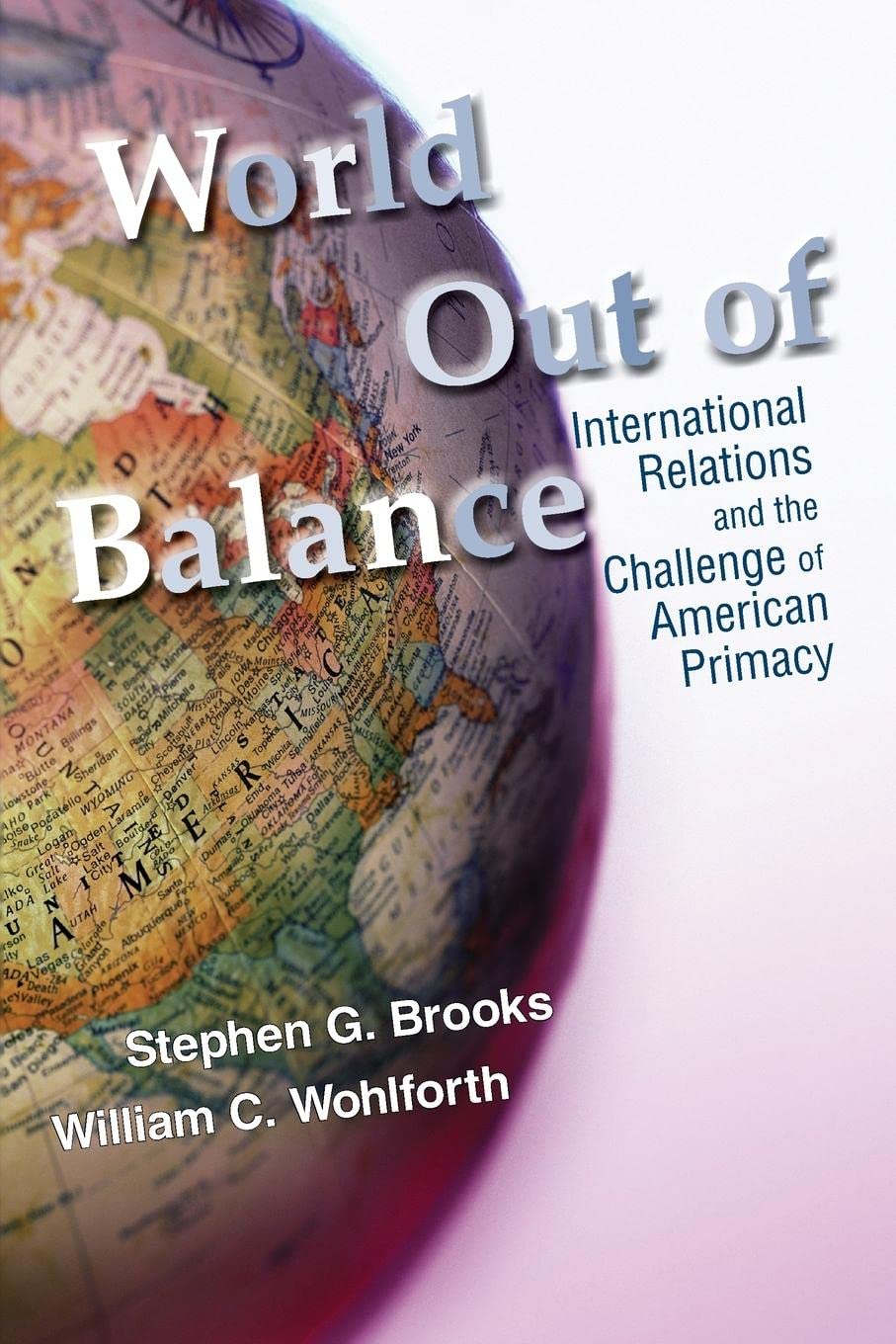
World Out of Balance: International Relations and the Challenge of American Primacy,New
Sold by Ergodebooks, an authorized reseller.
Returns accepted within 30 days | support@ergodebooks.com
Shipping Information
- Free Standard Shipping — United States only
- Processing Time: 3–5 business days
- Estimated Delivery: 6–10 business days after dispatch
- Double-boxed, fully insured & discreetly packaged
- Tracking number sent via email once dispatched
Returns & Refund
Returns accepted within 30 days of delivery.
Damaged or Defective Item
Free return shipping + replacement or full refund
Wrong Item Received
Free return shipping + replacement or full refund
Change of Mind
Return shipping at customer's expense · 25% restocking fee applies
Payment Option

World Out of Balance is the most comprehensive analysis to date of the constraints on the United States' use of power in pursuit of its security interests. Stephen Brooks and William Wohlforth overturn conventional wisdom by showing that in a unipolar system, where the United States is dominant in the scales of world power, the constraints featured in international relations theory are generally inapplicable. In fact, the authors argue that the U.S. will not soon lose its leadership position; rather, it stands before a twentyyear window of opportunity for reshaping the international system.Although American primacy in the world is unprecedented, analysts routinely stress the limited utility of such preeminence. The authors examine arguments from each of the main international relations theoriesrealism, institutionalism, constructivism, and liberalism. They also cover the four established external constraints on U.S. security policyinternational institutions, economic interdependence, legitimacy, and balancing. The prevailing view is that these external constraints conspire to undermine the value of U.S. primacy, greatly restricting the range of security policies the country can pursue. Brooks and Wohlforth show that, in actuality, the international environment does not tightly constrain U.S. security policy. World Out of Balance underscores the need for an entirely new research agenda to better understand the contours of international politics and the United States' place in the world order.
⚠️ WARNING (California Proposition 65):
This product may contain chemicals known to the State of California to cause cancer, birth defects, or other reproductive harm.
For more information, please visit www.P65Warnings.ca.gov.
- Q: How many pages does this book have? A: This book has two hundred forty-eight pages. It provides a comprehensive analysis of international relations and American primacy.
- Q: What is the binding of this book? A: This book is a paperback edition. Paperback bindings are flexible and lightweight, making them easy to carry around.
- Q: What are the dimensions of this book? A: The dimensions are six point two four inches in length, zero point six inches in width, and eight point nine inches in height. These measurements make it a convenient size for reading.
- Q: Who is the author of this book? A: The authors are Stephen G. Brooks and William Wohlforth. They are renowned scholars in the field of international relations.
- Q: What is the main topic of this book? A: The book discusses international relations and the challenge of American primacy. It provides a critical analysis of U.S. power and its implications.
- Q: What theories does this book examine? A: The book examines realism, institutionalism, constructivism, and liberalism. These theories provide various perspectives on U.S. foreign policy.
- Q: Is this book suitable for beginners in international relations? A: Yes, this book is suitable for beginners. It offers clear explanations of complex theories and presents a comprehensive overview of U.S. foreign policy.
- Q: Can this book be used for academic purposes? A: Yes, this book is ideal for academic purposes. It includes detailed analyses and is a valuable resource for students studying international relations.
- Q: What are the external constraints discussed in this book? A: The book discusses international institutions, economic interdependence, legitimacy, and balancing as external constraints. These factors influence U.S. security policy.
- Q: How can I keep this book in good condition? A: Store the book in a cool, dry place away from direct sunlight. Handle it carefully to avoid spine damage and creasing.
- Q: Is this book appropriate for all ages? A: Yes, this book is appropriate for ages sixteen and up. It contains complex themes suitable for mature readers.
- Q: What is the publication year of this book? A: The book was published in two thousand seven. It remains relevant in discussions about international relations.
- Q: Does this book contain any illustrations? A: No, this book does not contain illustrations. It focuses on text-based analysis of international relations.
- Q: What is the main argument of this book? A: The main argument is that the U.S. will not soon lose its leadership position. The authors highlight a window of opportunity for reshaping the international system.
- Q: Is this book considered a classic in its field? A: Yes, this book is considered a significant contribution to the field of international relations. It is frequently cited in academic literature.