If you have any questions, you are always welcome to contact us. We'll get back to you as soon as possible, withing 24 hours on weekdays.
Customer service
All questions about your order, return and delivery must be sent to our customer service team by e-mail at yourstore@yourdomain.com
Sale & Press
If you are interested in selling our products, need more information about our brand or wish to make a collaboration, please contact us at press@yourdomain.com
Help
If you have any questions, you are always welcome to contact us. We'll get back to you as soon as possible, withing 24 hours on weekdays.
Customer service
All questions about your order, return and delivery must be sent to our customer service team by e-mail at yourstore@yourdomain.com
Sale & Press
If you are interested in selling our products, need more information about our brand or wish to make a collaboration, please contact us at press@yourdomain.com
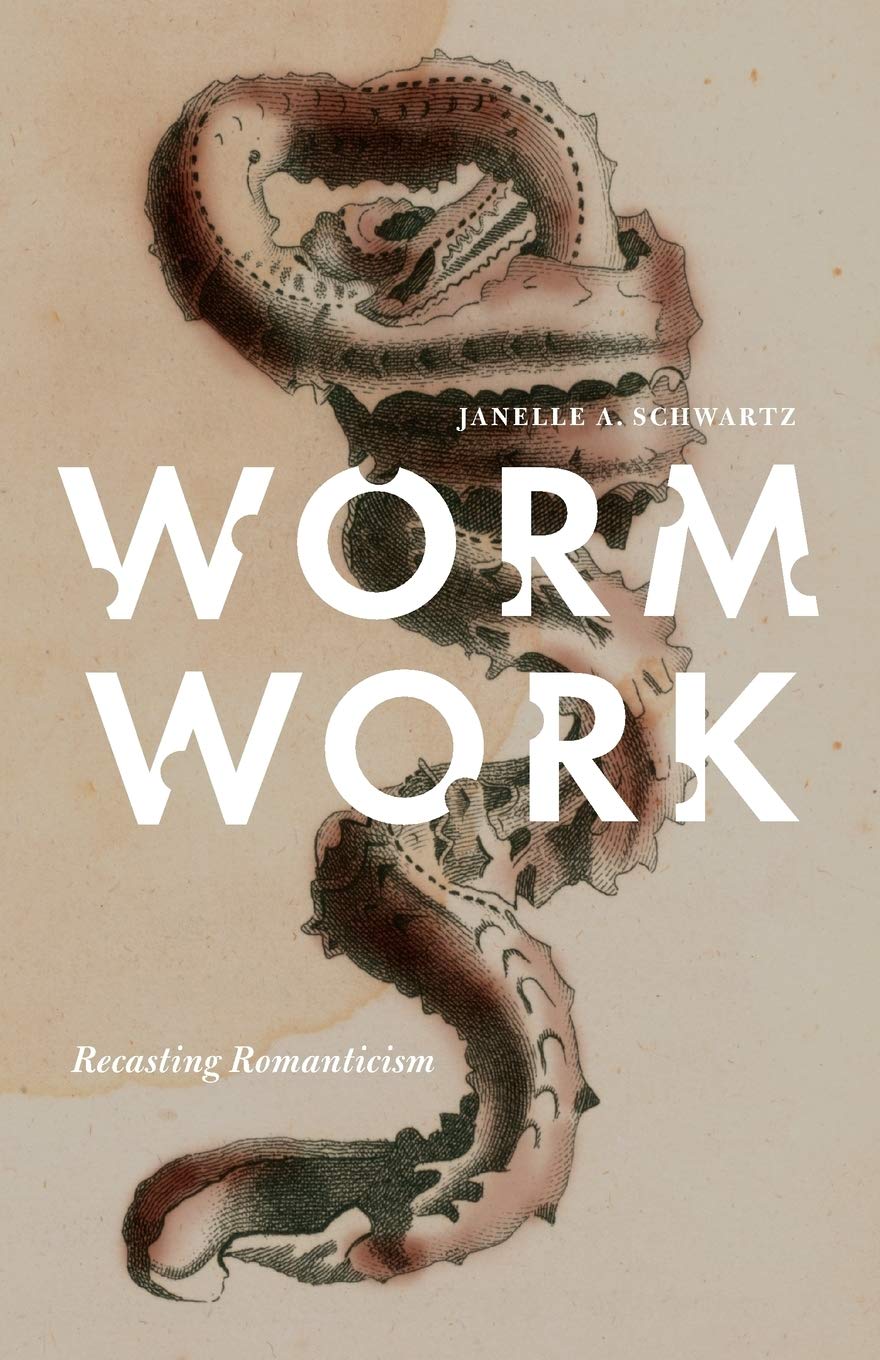
Worms. Natural history is riddled with them. Literature is crawling with them. From antiquity to today, the ubiquitous and multiform worm provokes an immediate discomfort and unconscious distancing: it remains us against them in anthropocentric anxiety. So there is always something muddled, or dirty, or even offensive when talking about worms. Rehabilitating the lowly worm into a powerful aesthetic trope, Janelle A. Schwartz proposes a new framework for understanding such a strangely animate nature. Worms, she declares, are the very matter with which the Romantics rethought the relationship between a material world in constant flux and the human mind working to understand it.Worm Work studies the lesserknown natural historical records of Abraham Trembley and his contemporaries and the familiar works of Erasmus Darwin, Charles Darwin, William Blake, Mary Shelley, and John Keats, to expose the worm as an organism that is not only reviled as a taxonomic terror but revered as a sign of great order in nature as well as narrative. This book traces a pattern of cultural production, a vermiculture that is as transformative of matter as it is of mind. It distinguishes decay or division as positive processes in Romantic era writings, compounded by generation or renewal and used to represent the biocentric, complex structuring of organicism.Offering the worm as an archetypal figure through which to recast the evolution of a literary order alongside questions of taxonomy from 1740 to 1820 and on, Schwartz unearths Romanticism as a rich humus of natural historical investigation and literary creation.
⚠️ WARNING (California Proposition 65):
This product may contain chemicals known to the State of California to cause cancer,
birth defects, or other reproductive harm.
For MAP (Minimum Advertised Price) violations and Intellectual Property (IP) or Trademark concerns, please contact:
support@ergodebooks.com
⚠️ California Proposition 65 Warning: Some products sold on this website may expose you to chemicals known to the State of California to cause cancer, birth defects, or other reproductive harm. For more information, visit www.P65Warnings.ca.gov.