
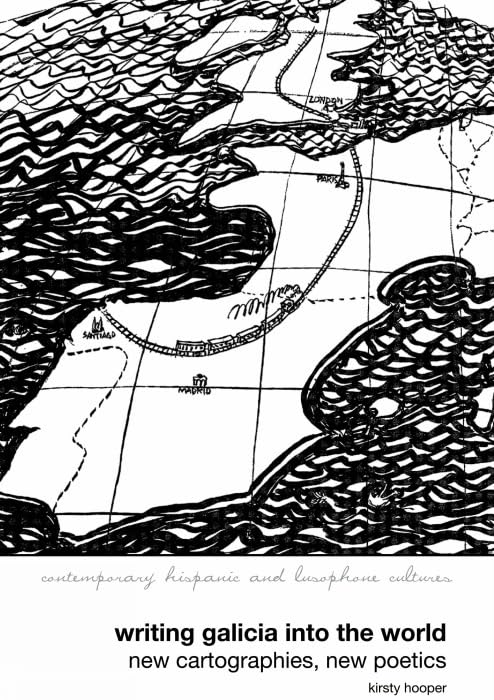
Title
Writing Galicia Into The World: New Cartographies, New Poetics (Contemporary Hispanic And Lusophone Cultures, 5)
Sold by Ergodebooks, an authorized reseller.
Returns accepted within 30 days | support@ergodebooks.com
Shipping Information
- Free Standard Shipping — United States only
- Processing Time: 3–5 business days
- Estimated Delivery: 6–10 business days after dispatch
- Double-boxed, fully insured & discreetly packaged
- Tracking number sent via email once dispatched
Returns & Refund
Returns accepted within 30 days of delivery.
Damaged or Defective Item
Free return shipping + replacement or full refund
Wrong Item Received
Free return shipping + replacement or full refund
Change of Mind
Return shipping at customer's expense · 25% restocking fee applies
Payment Option

Writing Galicia Explores A Part Of Europe'S Cultural And Social Landscape That Has Until Now Remained Largely Unmapped: The Exciting Body Of Creative Work Emerging Since The 1970S From Contact Between The Small Atlantic Country Of Galicia, In The Far Northwest Of The Iberian Peninsula, And The Anglophone World. Unlike The Millions Who Participated In The Mass Migrations To Latin America During The 19Th Century, Those Who Left Galicia For Northern Europe In Their Hundreds Of Thousands During The 1960S And 1970S Have Remained Mostly Invisible Both In Galicia And In Their Host Countries. This Study Traces The Innovative Mappings Of Galician Cultural History Found In Literary Works By And About Galicians In The Anglophone World, Paying Particular Attention To The Community Of 'London Galicians' And Their Descendants, In Works By Artists (Isaac Daz Pardo), Novelists (Carlos Durn, Manuel Rivas, Xess Fraga, Xels De Toro, Almudena Solana) And Poets (Ramiro Fonte, Xavier Queipo, Erin Moure). The Central
⚠️ WARNING (California Proposition 65):
This product may contain chemicals known to the State of California to cause cancer, birth defects, or other reproductive harm.
For more information, please visit www.P65Warnings.ca.gov.
- Q: What is the page count of 'Writing Galicia into the World'? A: This book has one hundred eighty-six pages. It provides an in-depth exploration of Galician culture and literature.
- Q: What type of binding does this book have? A: This book is hardcover bound. The hardcover design ensures durability and longevity for readers.
- Q: Who is the author of 'Writing Galicia into the World'? A: The author is Kirsty Hooper. Her research focuses on Galician cultural history and literature.
- Q: How do I read 'Writing Galicia into the World'? A: You can read this book like any other, starting from the first page to the last. It's suitable for anyone interested in cultural studies and literature.
- Q: Is this book appropriate for beginners in literary studies? A: Yes, it is suitable for beginners. The themes and discussions are accessible to those new to literary analysis.
- Q: What themes are explored in this book? A: The book explores themes of emigration, cultural nationalism, and the intersection of Galician and Anglophone cultures. It sheds light on a historically overlooked cultural landscape.
- Q: How should I store 'Writing Galicia into the World'? A: Store it in a cool, dry place away from direct sunlight. Keeping it on a bookshelf or in a protective sleeve will help maintain its condition.
- Q: Are there any special care instructions for this book? A: Avoid exposing the book to moisture and ensure it is handled with clean hands. This will help preserve the pages and binding.
- Q: What if I receive a damaged copy of the book? A: If you receive a damaged copy, contact the seller for a return or exchange. Ensure you keep the original packaging for the return process.
- Q: Does this book cover modern Galician literature? A: Yes, it discusses modern Galician literature and its interactions with the Anglophone world. It highlights significant authors and their contributions.
- Q: Is 'Writing Galicia into the World' suitable for academic use? A: Yes, it is suitable for academic purposes. The book provides valuable insights into Galician cultural studies and can serve as a resource for research.
- Q: Can I find this book in libraries? A: Yes, many academic libraries and public libraries may have this book in their collections. Check their catalogs for availability.
- Q: What makes this book a unique read? A: Its unique perspective on Galician culture and literature, particularly regarding emigration, sets it apart. It reexamines cultural narratives often overlooked.
- Q: Is there a specific audience for this book? A: The primary audience includes scholars, students, and anyone interested in Galician culture. It appeals to readers of contemporary literature and cultural studies.
- Q: How does this book contribute to understanding Galician identity? A: It models a relational approach to Galician cultural history, emphasizing the connections between local, national, and global narratives. It redefines Galician identity in a modern context.