
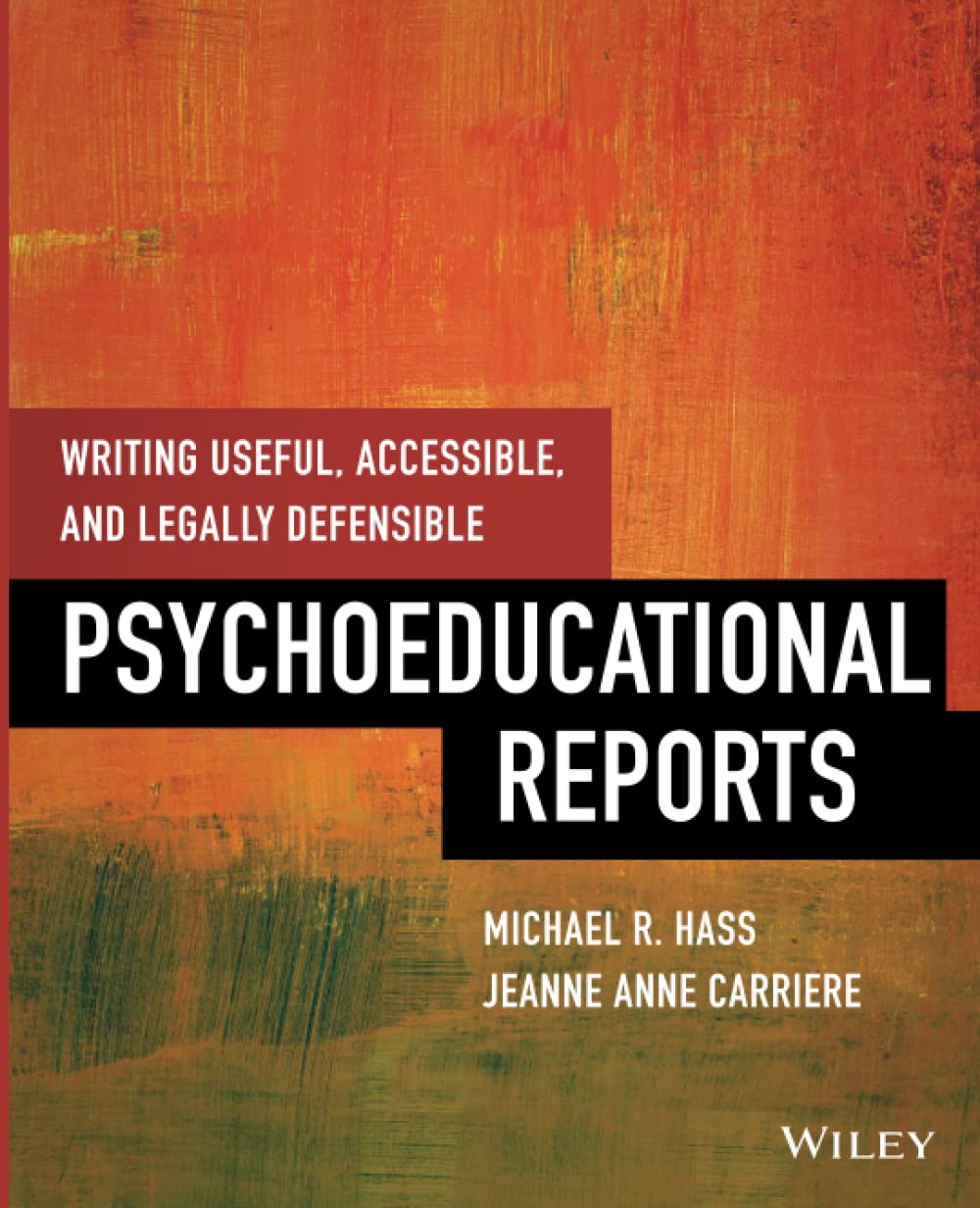
Title
Writing Useful, Accessible, and Legally Defensible Psychoeducational Reports,New
Sold by Ergodebooks, an authorized reseller.
Returns accepted within 30 days | support@ergodebooks.com
Shipping Information
- Free Standard Shipping — United States only
- Processing Time: 3–5 business days
- Estimated Delivery: 6–10 business days after dispatch
- Double-boxed, fully insured & discreetly packaged
- Tracking number sent via email once dispatched
Returns & Refund
Returns accepted within 30 days of delivery.
Damaged or Defective Item
Free return shipping + replacement or full refund
Wrong Item Received
Free return shipping + replacement or full refund
Change of Mind
Return shipping at customer's expense · 25% restocking fee applies
Payment Option

PRACTICAL GUIDANCE ON WRITING USEFUL, ACCESSIBLE, AND LEGALLY DEFENSIBLE PSYCHOEDUCATIONAL REPORTSFrom clearly identifying reasons for referral to making recommendations based on assessment results, Writing Useful, Accessible, and Legally Defensible Psychoeducational Reports offers practical guidance for creating reports that enhance the understanding of children and their strengths and challenges in order to better meet their educational and functional needs.The authors offer stepbystep guidelines for developing an assessment plan in a collaborative process with parents, teachers, and other professionals, choosing appropriate assessment and data collection tools, gathering relevant information, and providing clear and feasible individualized recommendations that directly respond to referral concerns in a format easily understood by parents and teachers.Ideal for graduate students in school psychology, school psychologists, and other professionals in related fields who work with children in a school setting, Writing Useful, Accessible, and Legally Defensible Psychoeducational Reports: Provides specific suggestions for increasing the usefulness and accessibility of reports including readability, positive phrasing, and vocabulary Illustrates how to develop wellformed questions and how to choose assessment tools to answer referral questions Reviews the legal mandates of report writing and discusses what must be included Demonstrates how to accurately document and integrate data from record review, interviews, observations, and tests Discusses how the use of the referralbased consultative assessment and report writing model can promote more active involvement in collaboration, prevention, and intervention Features numerous realworld cases, helpful checklists, examples of questiondriven referral reports, and a model interview protocol
⚠️ WARNING (California Proposition 65):
This product may contain chemicals known to the State of California to cause cancer, birth defects, or other reproductive harm.
For more information, please visit www.P65Warnings.ca.gov.
- Q: What is the main focus of 'Writing Useful, Accessible, and Legally Defensible Psychoeducational Reports'? A: The book focuses on providing practical guidance for writing psychoeducational reports that are useful, accessible, and legally defensible, specifically aimed at enhancing the understanding of children’s strengths and challenges.
- Q: Who is the target audience for this book? A: The target audience includes graduate students in school psychology, school psychologists, and other professionals working with children in educational settings.
- Q: What topics does the book cover regarding report writing? A: The book covers topics such as developing assessment plans, choosing assessment tools, legal mandates of report writing, and providing individualized recommendations.
- Q: How does the book suggest improving the readability of reports? A: It provides specific suggestions for increasing readability, including the use of positive phrasing and appropriate vocabulary to make reports more accessible for parents and teachers.
- Q: Does the book include real-world examples? A: Yes, it features numerous real-world cases, checklists, and examples of question-driven referral reports to illustrate the concepts discussed.
- Q: What is the publication date of this book? A: The book was published on April 7, 2014.
- Q: How many pages does the book have? A: The book contains 224 pages.
- Q: What binding type is used for this book? A: The book is available in paperback binding.
- Q: Are there any specific guidelines for collaborative assessment mentioned in the book? A: Yes, the book discusses a referral-based consultative assessment model that promotes active involvement in collaboration and intervention processes.
- Q: Who are the authors of this book? A: The book is authored by Michael Hass.