
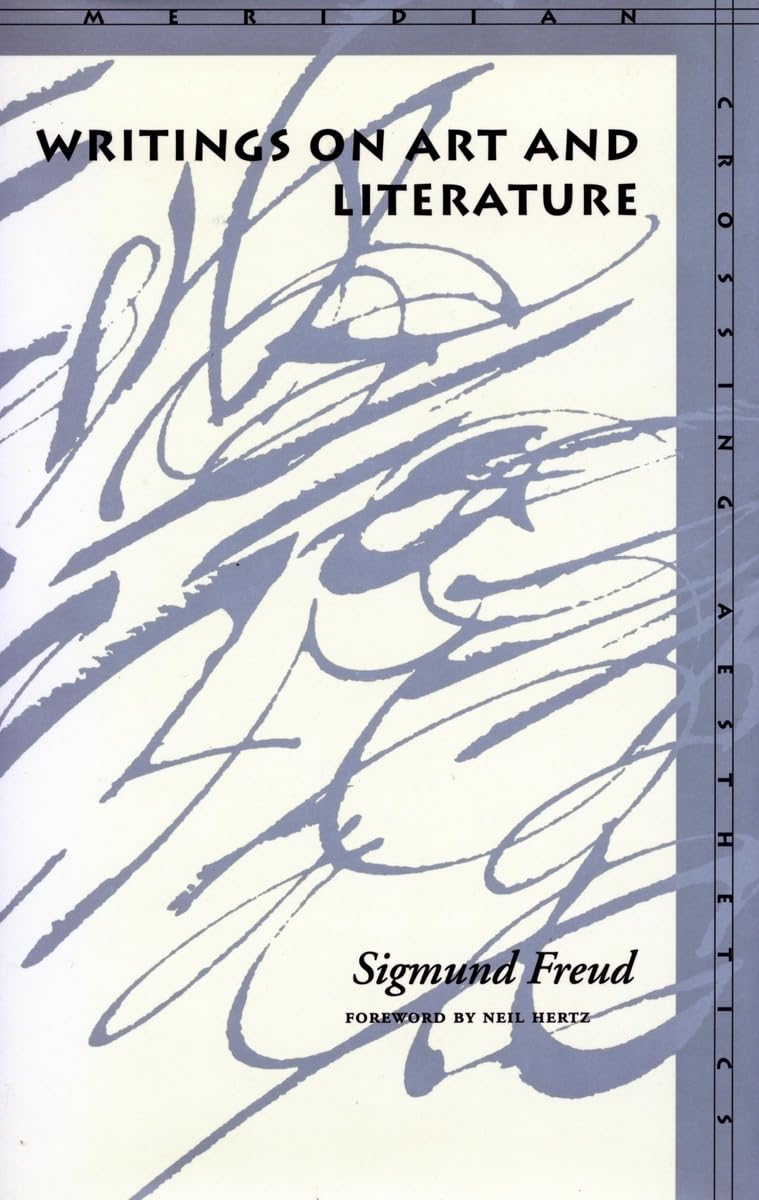
Title
Writings on Art and Literature (Meridian: Crossing Aesthetics),New
Sold by Ergodebooks, an authorized reseller.
Returns accepted within 30 days | support@ergodebooks.com
Shipping Information
- Free Standard Shipping — United States only
- Processing Time: 3–5 business days
- Estimated Delivery: 6–10 business days after dispatch
- Double-boxed, fully insured & discreetly packaged
- Tracking number sent via email once dispatched
Returns & Refund
Returns accepted within 30 days of delivery.
Damaged or Defective Item
Free return shipping + replacement or full refund
Wrong Item Received
Free return shipping + replacement or full refund
Change of Mind
Return shipping at customer's expense · 25% restocking fee applies
Payment Option

Despite Freud's enormous influence on twentiethcentury interpretations of the humanities, there has never before been in English a complete collection of his writings on art and literature. These fourteen essays cover the entire range of his work on these subjects, in chronological order beginning with his first published analysis of a work of literature, the 1907 'Delusion and Dreams in Jensen's Gradiva' and concluding with the 1940 posthumous publication of 'Medusa's Head.' Many of the essays included in this collection have been crucial in contemporary literary and art criticism and theory. Among the subjects Freud engages are Shakespeare's Hamlet, The Merchant of Venice, King Lear, and Macbeth, Goethe's Dichtung und Wahrheit, Michelangelo's Moses, E. T. A. Hoffman's 'The Sand Man,' Dostoevsky's The Brothers Karamazov, fairy tales, the effect of and the meaning of beauty, mythology, and the games of aestheticization. All texts are drawn from The Standard Edition of the Complete Psychological Works of Sigmund Freud, edited by James Strachey. The volume includes the notes prepared for that edition by the editor. In addition to the writings on Jensen's Gradiva and Medusa, the essays are: 'Psychopathic Characters on the Stage,' 'The Antithetical Meaning of Primal Words,' 'The Occurrence in Dreams of Material from Fairy Tales,' 'The Theme of the Three Caskets,' 'The Moses of Michelangelo,' 'Some Character Types Met with in Psychoanalytic Work,' 'On Transience,' 'A Mythological Parallel to a Visual Obsession,' 'A Childhood Recollection from Dichtung und Wahrheit,' 'The Uncanny,' 'Dostoevsky and Parricide,' and 'The Goethe Prize.'
⚠️ WARNING (California Proposition 65):
This product may contain chemicals known to the State of California to cause cancer, birth defects, or other reproductive harm.
For more information, please visit www.P65Warnings.ca.gov.
- Q: How many pages does the book have? A: This book has three hundred twenty pages. It provides extensive insights into Sigmund Freud's perspectives on art and literature.
- Q: What is the binding type of this book? A: The book is available in paperback binding. This makes it lightweight and portable for easy reading.
- Q: What are the dimensions of the book? A: The book measures five point five one inches in length, zero point eight inches in width, and eight point five inches in height. These dimensions make it a convenient size for handling.
- Q: Who is the author of this book? A: The author of this book is Sigmund Freud. He is a renowned figure in psychology and his writings significantly influence literary and art criticism.
- Q: What is the main subject of the book? A: The main subject of the book is Freud's writings on art and literature. It includes critical essays reflecting his analysis of various literary works.
- Q: How do I read and understand the essays? A: You can read the essays in chronological order for a comprehensive understanding of Freud's evolving thoughts. Each essay explores different themes in literature and art.
- Q: Is this book suitable for beginners in literary criticism? A: Yes, this book is suitable for beginners. Freud's essays provide foundational insights that can enhance understanding of literary and art criticism.
- Q: Can I use this book for academic purposes? A: Yes, this book is suitable for academic purposes. It is a valuable resource for students studying psychology, literature, and art criticism.
- Q: How should I store this book to keep it in good condition? A: Store the book in a cool, dry place away from direct sunlight. This will help preserve its quality and prevent wear and tear.
- Q: Is it safe to read this book around children? A: Yes, it is generally safe to read this book around children. However, some themes may be complex and require adult supervision for discussion.
- Q: What if I receive a damaged copy of the book? A: If you receive a damaged copy, you should contact the seller immediately for a return or exchange. Most retailers offer return policies for damaged items.
- Q: What is the publisher of this book? A: The publisher of this book is Stanford University Press. They are known for their scholarly publications in various fields.
- Q: Are there any notable essays included in this collection? A: Yes, notable essays include 'The Uncanny' and 'Dostoevsky and Parricide.' These essays are significant in the study of psychoanalysis and literature.
- Q: Can this book help in understanding Freud's theories? A: Yes, this book provides insights into Freud's theories as applied to literature and art. It is essential for understanding his broader impact on the humanities.
- Q: Is this book a good gift for literature enthusiasts? A: Yes, this book makes an excellent gift for literature enthusiasts. It offers deep insights into literary criticism from a psychological perspective.