
Title
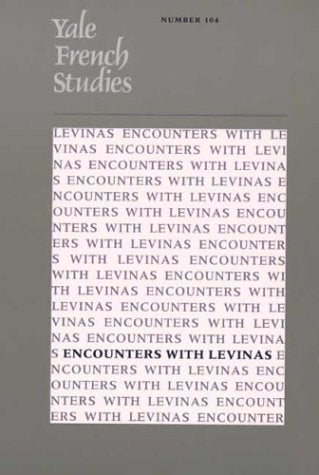
Yale French Studies 104: Encounters with Levinas,New
Sold by Ergodebooks, an authorized reseller.
Returns accepted within 30 days | support@ergodebooks.com
Shipping Information
- Free Standard Shipping — United States only
- Processing Time: 3–5 business days
- Estimated Delivery: 6–10 business days after dispatch
- Double-boxed, fully insured & discreetly packaged
- Tracking number sent via email once dispatched
Returns & Refund
Returns accepted within 30 days of delivery.
Damaged or Defective Item
Free return shipping + replacement or full refund
Wrong Item Received
Free return shipping + replacement or full refund
Change of Mind
Return shipping at customer's expense · 25% restocking fee applies
Payment Option

Product DescriptionThomas TreziseEditors PrefaceLeora BatnitzkyEncountering the Modern Subject in LevinasSamuel MoynTranscendence, Morality, and History: Emmanuel Levinas and the Discovery of Soren Kierkegaard in FranceAlain ToumayanI more than the others: Dostoevsky and LevinasLuce IrigarayWhat Other Are We Talking About?Paul RicoeurOtherwise: A Reading of Emmanuel Levinass Otherwise than Being or Beyond EssencePhilippe CrignonFiguration: Emmanuel Levinas and the ImageEdith WyschogrodLevinass Other and the Culture of the CopyFrom the Back CoverAUTHORBIOExcerpt. Reprinted by permission. All rights reserved.Yale French StudiesEncounters with Levinas Yale University PressCopyright 2004 Yale UniversityAll right reserved.ISBN: 9780300102161ContentsTHOMAS TREZISE Editor's Preface.........................................................................................................1LEORA BATNITZKY Encountering the Modern Subject in Levinas..............................................................................6SAMUEL MOYN Transcendence, Morality, and History: Emmanuel Levinas and the Discovery of Sren Kierkegaard in France.....................22ALAIN TOUMAYAN 'I more than the others': Dostoevsky and Levinas.........................................................................55LUCE IRIGARAY What Other Are We Talking About?..........................................................................................67PAUL RICOEUR Otherwise: A Reading of Emmanuel Levinas's Otherwise than Being or Beyond Essence..........................................82PHILIPPE CRIGNON Figuration: Emmanuel Levinas and the Image.............................................................................100EDITH WYSCHOGROD Levinas's Other and the Culture of the Copy............................................................................126Chapter OneLEORA BATNITZKYEncountering the Modern Subject in LevinasINTRODUCTIONThe scholarly literature on Levinas and Descartes is surprisingly sparse, given Levinas's bold claims in Totality and Infinity that he is drawing on a number of profound Cartesian insights. Some attention has been given to Levinas's use of Descartes's conception of infinity and some to his use of Descartes's evil genius in arguing for a goodness beyond being. My focus in this essay, however, is on Levinas's appropriation of Descartes's philosophy in order to argue for a separable, independent subject. Levinas's claim about ethics rests upon his elucidation of the subject of ethics, the 'I' who is uniquely responsible. It is the separate, independent, indeed atheistic self that he means to affirm in Totality and Infinity. Despite his arguments about the inability of philosophy to grasp the face of the other, Levinas's project is nothing short of a defense of the modern philosophical projectand the modern subject in particularafter Heidegger.If postmodern philosophy takes as its villain the subject of Descartes's cogito, the reading of Levinas presented in this essay calls into question the view of Levinas as a 'postmodern' thinker. I argue in what follows that Levinas's phenomenological description of the subject in Totality and Infinity, and also in Otherwise than Being, bears its greatest debt to Descartes. Levinas in fact presents his readers with an ethical encounter with Descartes's modern subjectan encounter that he claims is already present in Descartes.Yet surely, one would quickly reply, Levinas's subject is not Descartes's subject. I argue in what follows, however, that the subject described by Totality and Infinity is none other than Descartes's socalled modern subject. In an important sense, this claim isn't even a claim because Levinas says as much. If Heidegger, in Being and Time, takes Descartes to have expressed and determined the modern dichotomy between subject and object, Levinas seeks nothing less than to reaffirm such a distinction. In order to app
⚠️ WARNING (California Proposition 65):
This product may contain chemicals known to the State of California to cause cancer, birth defects, or other reproductive harm.
For more information, please visit www.P65Warnings.ca.gov.