If you have any questions, you are always welcome to contact us. We'll get back to you as soon as possible, withing 24 hours on weekdays.
Customer service
All questions about your order, return and delivery must be sent to our customer service team by e-mail at yourstore@yourdomain.com
Sale & Press
If you are interested in selling our products, need more information about our brand or wish to make a collaboration, please contact us at press@yourdomain.com
Help
If you have any questions, you are always welcome to contact us. We'll get back to you as soon as possible, withing 24 hours on weekdays.
Customer service
All questions about your order, return and delivery must be sent to our customer service team by e-mail at yourstore@yourdomain.com
Sale & Press
If you are interested in selling our products, need more information about our brand or wish to make a collaboration, please contact us at press@yourdomain.com
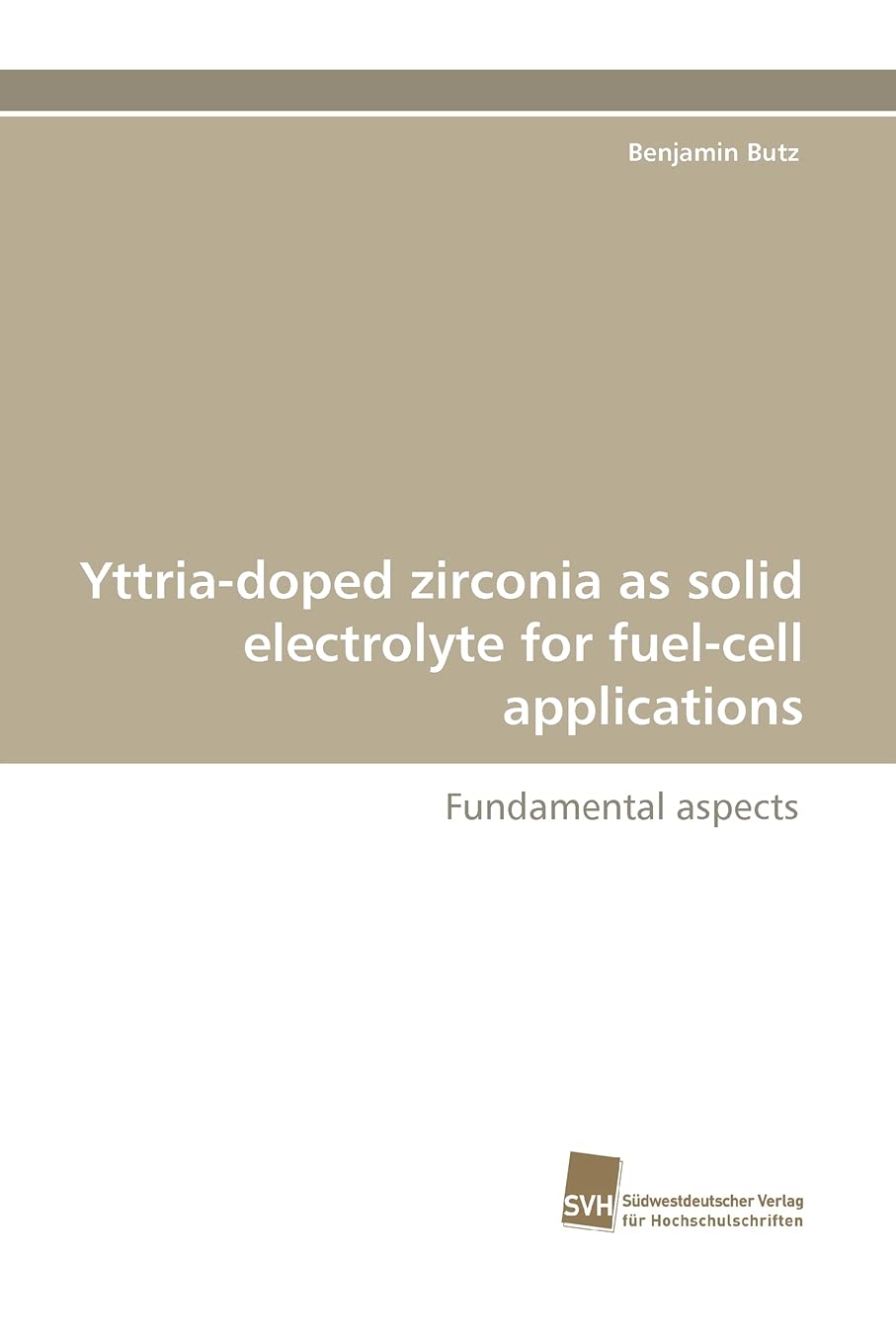
Yttriadoped zirconia (YDZ) has been used as electrolyte for solid oxide fuel cells (SOFCs) for many years. Nevertheless, fundamental questions regarding the thermal stability and thus the degradation of ionic conductivity of YDZ are controversially discussed in literature. In this study, thickfilm and solgel prepared thinfilm YDZ electrolytes with yttria concentrations in the range of 7.310 mol% were investigated by transmission electron microscopy (TEM) with emphasis on microstructural and chemical changes during hightemperature operation. In general, nanoscaled regions of metastable tetragonal YDZ were found in all investigated specimens. Depending on dopant concentration and thermal treatment, the microstructural and chemical decomposition of the material on the scale of 10 nm could be shown by quantitative analytical TEM. Hence, clarifying conclusions regarding the YDZ phase diagram in the targeted dopant range are drawn. A revised boundary of the instability region, in which YDZ has to be expected to decompose, is presented. In conclusion, the developing inhomogeneities in decomposing YDZ are discussed as reason for the decrease of ionic conductivity during operation.
⚠️ WARNING (California Proposition 65):
This product may contain chemicals known to the State of California to cause cancer,
birth defects, or other reproductive harm.
For MAP (Minimum Advertised Price) violations and Intellectual Property (IP) or Trademark concerns, please contact:
support@ergodebooks.com
⚠️ California Proposition 65 Warning: Some products sold on this website may expose you to chemicals known to the State of California to cause cancer, birth defects, or other reproductive harm. For more information, visit www.P65Warnings.ca.gov.