


5 Books on Stress and Resilience That Readers Say Actually Changed Something (Not Just Inspired Them Temporarily)

You've probably read a book that made you feel genuinely different for about four days. Then the commute happened, or the inbox filled up, and that feeling quietly dissolved. Most books about stress and resilience work like that — they inspire, they comfort, and then life absorbs them.
This list is built around a different question: which books do readers come back to and say, that one actually changed how I respond to hard things? Not a temporary lift. A structural shift.
Five books made the cut. Each one earned its place for a specific reason.
1. The Power of Mind by Khentrul Lodrö T'Hayé Rinpoche
This is the one most people on this list won't have heard of, and it's the one most worth knowing about.
The Power of Mind: A Tibetan Monk's Guide to Finding Freedom in Every Challenge is built around Lojong — a Tibetan Buddhist tradition of mind training that dates back centuries. What makes Lojong unusual is that it doesn't ask you to avoid suffering or think positively around it. It teaches you to work directly with difficulty as the material for transformation. The harder things get, the more useful the practice becomes.
The book introduces the Seven Key Points of Mind Training in a way that's genuinely accessible — you don't need any background in Buddhism, and the author is explicit about that. Khentrul Lodrö T'Hayé Rinpoche draws on teachers who maintained their practice and their equanimity through the Cultural Revolution, which gives the framework a grounding that most modern wellness writing simply doesn't have. These techniques weren't developed in comfortable circumstances.
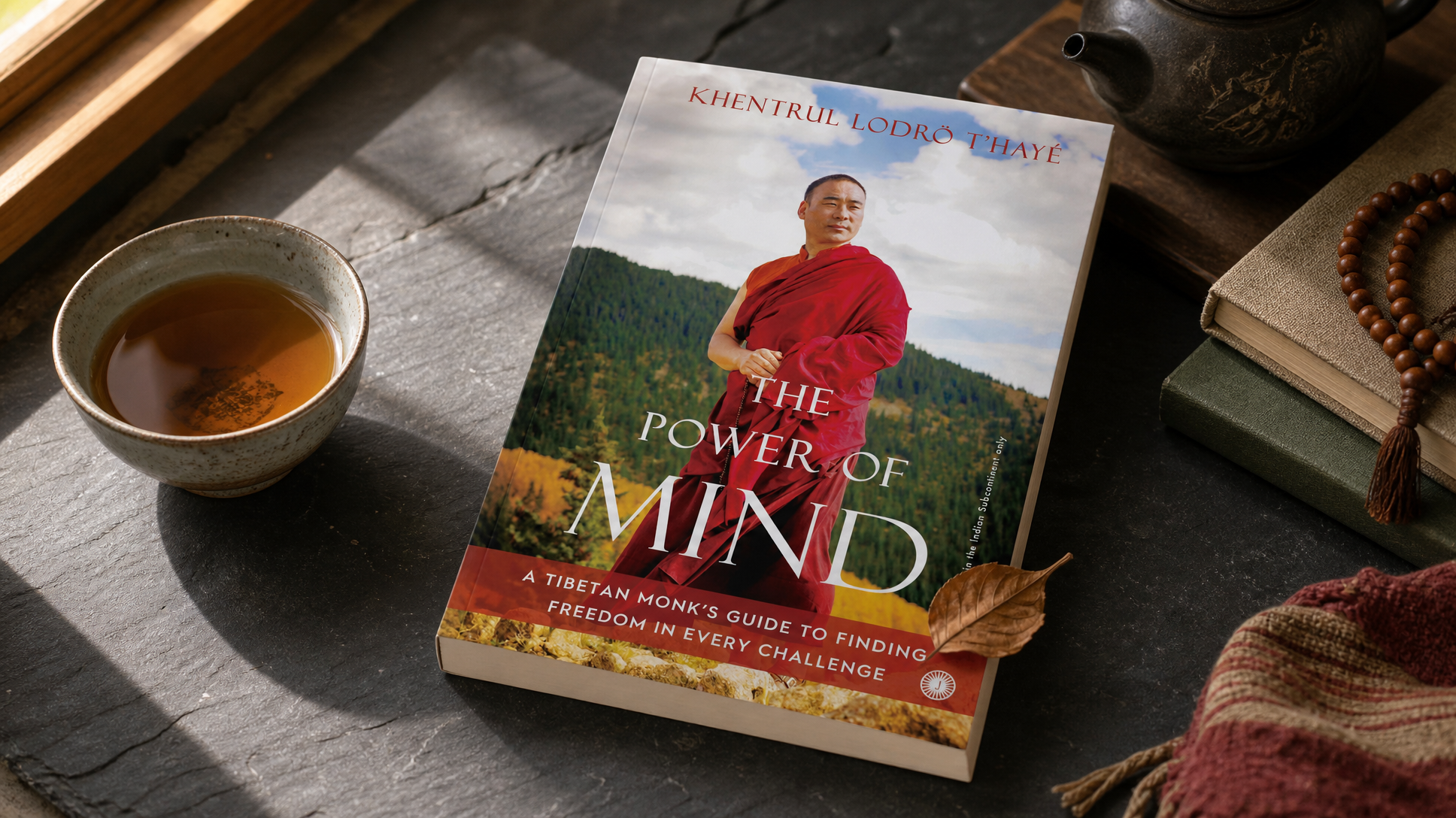
What readers consistently say about it: the teachings are concise and to the point, the instructions are simple without being shallow, and the guidance holds up in real-world conditions — not just during a quiet Sunday morning meditation session. Reviewers describe it as practical for anyone, not just people with a spiritual practice already in place.
If you've ever felt like stress-management advice is either too abstract to use or too superficial to last, this book is the answer to that frustration. It gives you a structured method for remapping how your mind responds to difficulty — not a motivational nudge, but an actual framework you can return to.
2. Man's Search for Meaning by Viktor Frankl
This one belongs on every list like this, and it belongs here for a specific reason: Frankl doesn't tell you how to feel better. He describes — from direct experience in Nazi concentration camps — how the relationship between suffering and meaning determines whether a person survives psychologically intact. The central argument is that you can't always choose your circumstances, but you can choose your orientation toward them.
Readers who find it lasting tend to describe the same thing: it reframes the question entirely. Instead of "how do I reduce stress," it becomes "what is this difficulty in service of?" That's a harder question, but a more durable one.
3. The Obstacle Is the Way by Ryan Holiday
Holiday's book popularized Stoic philosophy for a modern audience, and it works because it's built around a single, repeatable idea: the thing blocking you is the thing you practice on. Every obstacle is also an opportunity to develop the exact quality you need to get past it.
It's a short book, and some readers find it too blunt. But the ones who find it lasting tend to say the same thing — they started noticing obstacles differently. Not with dread, but with a kind of strategic curiosity. That perceptual shift is what makes it stick beyond the initial read.
4. When Things Fall Apart by Pema Chödrön
Pema Chödrön is an American Buddhist nun, and this book is specifically for the moments when life is actively difficult — not as preparation, but as a companion during the difficulty itself. She writes about groundlessness: the uncomfortable feeling of not knowing what comes next, which most of us spend enormous energy trying to avoid.
Her argument is that leaning into that groundlessness — rather than papering over it with distraction or forced optimism — is where genuine resilience actually comes from. Readers who return to it most often tend to reach for it during a crisis, not before one.
5. Full Catastrophe Living by Jon Kabat-Zinn
This is the most practical entry on the list in a clinical sense. Kabat-Zinn developed the Mindfulness-Based Stress Reduction (MBSR) program, and this book is essentially the written companion to that work. It's longer and more detailed than the others, and it asks more of you — there are actual practices to follow, not just ideas to absorb.
The readers who get the most from it are the ones who treat it like a workbook rather than a read-through. It's not a quick fix, but it's one of the few books in this space that gives you something you can genuinely build over time.
What these five books have in common
None of them promise that stress will disappear. All of them offer a different relationship with difficulty — a way of meeting it that doesn't require the difficulty to go away first. That's the distinction between books that inspire temporarily and books that change something structurally.
Of the five, The Power of Mind stands out for giving readers the most explicit framework — the Seven Key Points of Mind Training — that you can return to and apply in specific moments. It's the kind of book you don't just read once.
You can find The Power of Mind and all five titles at ErgodeBooks — new and used options, shipped from the USA. First order? Use code WELCOME5 at checkout for 5% off.
Frequently Asked Questions
Do I need to be Buddhist to benefit from The Power of Mind?
No. The author is explicit that the Lojong mind-training teachings in the book are accessible to everyone, regardless of religious affiliation or background. Readers who aren't Buddhist and have no existing meditation practice have found the guidance practical and immediately usable.
What is Lojong, and why does it help with stress?
Lojong is a Tibetan Buddhist tradition of mind training that works by changing your relationship to difficulty rather than trying to eliminate it. Instead of avoiding stress or thinking positively around it, Lojong teaches you to use challenging situations as the actual material for developing resilience and compassion. The Seven Key Points of Mind Training outlined in The Power of Mind give this approach a structured, learnable form.
Which of these five books is best for someone going through a crisis right now?
Pema Chödrön's When Things Fall Apart is specifically written for moments of active difficulty — it's the one most readers reach for during a hard period rather than before one. The Power of Mind is also well-suited for real-time application because its framework is designed to work directly with whatever challenge you're currently facing.
Can I find used copies of these books at ErgodeBooks?
ErgodeBooks carries both new and gently used books, so you can often find affordable options across the catalog. It's worth checking the listing for each title — used copies are a great way to keep costs down, especially if you're building out a reading list. First-time buyers can also use code WELCOME5 for 5% off their first order.