


eBook vs. Physical Book for Studying: Which Format Actually Helps You Retain More?

Most students choose their study format the same way they choose a seat in the library: out of habit, or because it's the first option available. The eBook wins on price and convenience, so it usually gets the default. But if you've ever read twenty pages on a screen and retained almost nothing, you already know that "cheapest" and "most effective" aren't always the same thing.
The honest answer to which format is better for studying is: it depends — but not on vague things like "learning style." It depends on the type of material, how you interact with the text, and what retention actually looks like for that subject. Here's how to think through it.
What the Research Actually Says
A growing body of research has looked at how reading medium affects comprehension and retention. The consistent finding is that readers tend to do better on deeper comprehension tasks — understanding main arguments, making inferences, recalling the sequence of events — when reading in print rather than on a screen. A widely cited meta-analysis published in Educational Research Review found a meaningful advantage for print reading, particularly for expository (non-narrative) texts and timed reading conditions.
That said, the gap narrows significantly for shorter texts, factual recall tasks, and readers who are practiced digital annotators. It's not that screens are inherently bad for learning — it's that most people read digital text in a shallower mode: faster, more skimming, less re-reading. The medium doesn't cause shallow reading, but it makes it easier to slip into.
When Print Has a Genuine Edge
Dense, argument-heavy material. Philosophy, economics, law, history — subjects where you need to follow a sustained line of reasoning across many pages. Physical books let you hold your place, flip back, and get a sense of how far through a chapter you are. That spatial awareness of "I'm about two-thirds through this section" is a real cognitive anchor that screens mostly strip away.
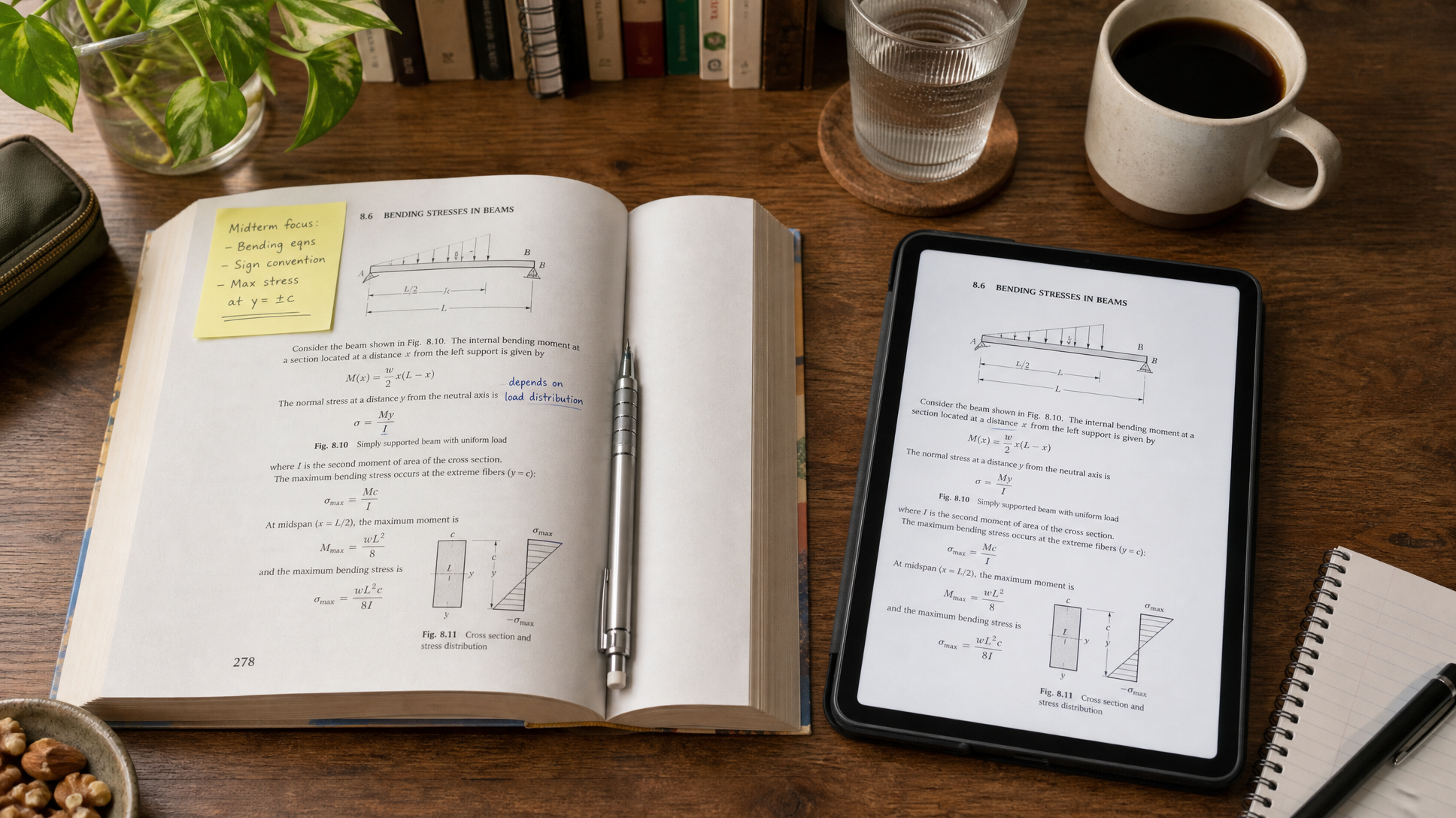
Math and sciences with diagrams. Flipping between a diagram on page 47 and the explanation on page 52 is genuinely easier in print. On a tablet or laptop, you're either zooming in and losing context or scrolling back and forth and losing your place.
When you annotate heavily. Handwritten margin notes beat digital highlights for most people. The act of physically writing — not typing — a note in the margin forces you to compress and rephrase, which is itself a retention technique. If your study method involves a lot of active annotation, print is usually worth the extra cost.
High-stakes exams. If your exam is on paper, studying on paper keeps you in the right cognitive mode. It sounds simple, but the format of your practice should match the format of your test where possible.
When the eBook Actually Works Better
Reference and lookup-heavy studying. If you're working through a programming textbook, a language learning guide, or any material where you're constantly jumping to a specific term or section, the search function in an eBook is genuinely superior. Ctrl+F beats an index every time.
Supplementary reading. Not every assigned reading needs to go deep. If you're skimming a chapter to get the gist before a lecture, or reading a secondary source to get background context, an eBook is perfectly fine — and significantly cheaper.
Portability constraints. A 900-page anatomy textbook is a physical problem. If carrying the print edition means you leave it at home and don't study at all, the eBook you actually open wins by default.
Budget-limited students. This is real and it matters. An eBook at a fraction of the cost of a new print edition is often the practical choice, especially for a course you're less invested in. Used print books close the price gap considerably, but for brand-new titles, digital is often the more affordable path.
The Hybrid Approach Most Students Overlook
The sharpest students tend not to pick one format and stick to it rigidly. They use eBooks for initial reading and orientation — getting the lay of the land, searching for key terms, reading supplementary material — and then buy used print editions of the two or three core texts they'll return to repeatedly across a semester.
That combination gives you the cost savings of digital for lower-stakes reading and the retention benefits of print for the material that actually matters on the exam. It's not about loyalty to a format; it's about matching the tool to the task.
A Quick Decision Framework
- Is this a core text you'll study deeply and return to often? → Print, ideally used to keep costs down.
- Is this supplementary, reference-based, or background reading? → eBook works fine.
- Does the subject involve complex diagrams, charts, or equations? → Print is easier to navigate.
- Do you annotate heavily as a study method? → Print wins.
- Are you primarily searching and looking things up? → eBook's search function is your friend.
- Is the print edition genuinely out of your budget? → Check for a used copy first; if not available, eBook beats not reading at all.
One Habit That Matters More Than Format
Here's the thing the format debate often misses: active reading beats passive reading in either medium. If you're highlighting everything, you're retaining nothing. If you're reading without stopping to summarize or question, the format won't save you. The research advantage for print largely reflects the fact that print readers tend to read more slowly and deliberately — but a disciplined digital reader who pauses, takes notes, and re-reads difficult passages can close that gap significantly.
Pick the format that makes you more likely to read actively. For most people, that's print for core material. But knowing yourself matters more than following a rule.
ErgodeBooks carries both print editions and eBooks across textbooks, non-fiction, and educational titles — including new copies and gently used options that make print more affordable than you might expect. If you're stocking up for a semester or building out a study library, browse the full catalog at ErgodeBooks and use code WELCOME5 for 5% off your first order.
And if you're buying books for someone else and aren't sure where to start, our guide on how to buy books as gifts might help.
Frequently Asked Questions
Is reading on a tablet better than reading on a phone for studying?
Generally, yes — a larger screen reduces the amount of scrolling and gives you more of the page at once, which helps with comprehension. Tablets can also display diagrams and charts at a more readable size. That said, neither matches the spatial awareness and annotation ease of a physical book for deep study sessions.
Do used textbooks work as well as new ones for studying?
In most cases, yes. The content in a used edition is the same, and previous annotations from another student can sometimes be helpful (though they can also be a distraction). The main risk is buying a significantly older edition when the course requires a specific newer one — always check the edition number your instructor specifies before buying used.
Can I switch between eBook and print for the same course?
Absolutely, and many students find this works well. A common approach is using the eBook for initial reading and reference lookups, then using a print copy for the focused study sessions where you annotate and review before exams. The two formats complement each other rather than compete.
What's the best way to annotate an eBook if I don't have the print version?
Most eBook platforms let you highlight and add typed notes, but the retention benefit of handwriting is largely lost. A practical workaround: keep a physical notebook open alongside your eBook and write your margin notes there by hand, linked to chapter and section. It adds a step, but the act of handwriting the note does more cognitive work than typing a highlight comment.